Most locksmith advertising fails because operators chase volume without understanding their actual capacity constraints. You burn through budget on lockouts at 11 PM that destroy your margin, or you get flooded with 'just checking prices' calls that never convert. The real leverage comes from locksmith lead generation systems that pre-qualify intent, service type, and urgency before a single dispatch hour gets allocated.
This isn't about getting more leads. It's about engineering your inbound pipeline so every contact matches your crew availability, service radius, and revenue model.
The operators who scale profitably do one thing differently: they define lead specifications upfront and disqualify aggressively. They know their unit economics down to the service type, time of day, and ZIP code. They don't advertise locksmith advertising generically—they architect funnels that route residential rekeys, commercial access control, and automotive jobs through completely different qualification paths.
If your current advertising produces a 40% contact-to-dispatch rate, you're likely leaving 60% margin on the table through misallocated capacity.
"We define lead specs upfront to ensure outcomes without wasting capacity."
Challenge: Undifferentiated Locksmith Advertising Attracts Emergency-Only Traffic
The default locksmith advertising playbook targets one keyword cluster: lockouts. This creates a revenue ceiling because emergency calls have predictable limitations—low ticket averages ($75-$150), off-hours dispatch premiums, and zero upsell opportunity.
You end up competing in the highest-cost, lowest-margin segment. Your cost-per-click spikes during peak lockout hours (Sunday nights, holidays), and you're bidding against aggregators with venture capital backing who don't care about profitability.
The structural problem: emergency traffic has inverse economics. High urgency means lower price sensitivity initially, but it also means the customer has zero loyalty post-service. They never call you again because they don't plan to get locked out again.
Meanwhile, planned service revenue—rekeys after a home purchase, master key systems for property managers, commercial door hardware installs—sits untouched. These jobs have $300-$1,500 ticket averages, normal business hours, and referral potential.
But most locksmith advertising treats all inquiries identically. No differentiation between a panic call and a planned project. No separate funnels. No intent-based qualification.
Solution: Segment Advertising by Service Intent and Revenue Potential
The fix requires splitting your advertising into three distinct intent tracks, each with custom qualification logic:
Track 1: Emergency Lockout (Defensive Positioning)
You can't ignore this vertical—it drives brand awareness—but you contain it. Set a fixed budget cap, target only your core service radius, and use availability-based throttling. If your night crew is at capacity, pause the ads. Don't pay for leads you can't monetize.
Qualification checkpoint: Validate the address is within your 15-minute response zone. Confirm they understand your emergency rate structure ($150 minimum). Disqualify if they're calling multiple services simultaneously (price shopping equals low close rate).
Track 2: Residential Planned Service (Growth Engine)
This is where margin lives. Target homeowners who just closed on a property, renters moving into new units, or security-conscious buyers researching smart locks. These prospects have 7-14 day decision windows, which gives you time to qualify properly.
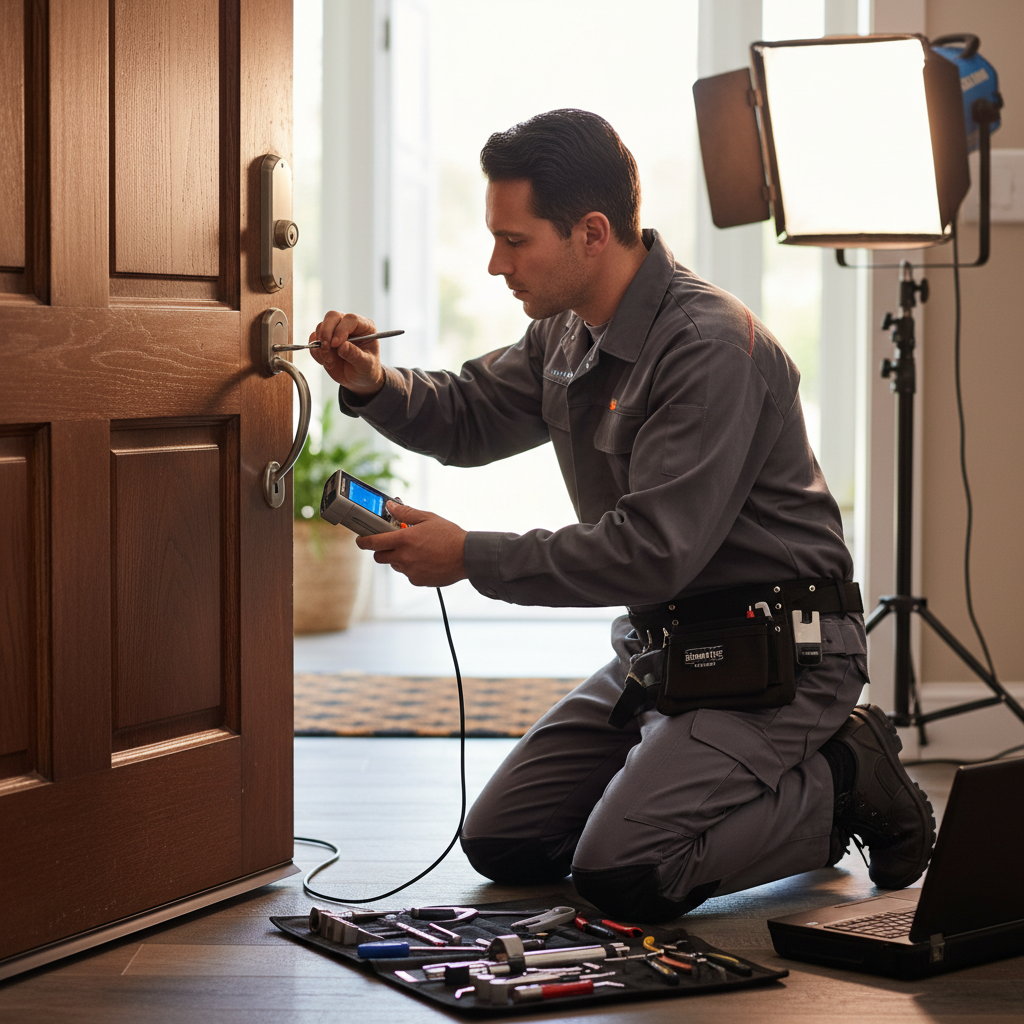
Your advertising here focuses on trust signals: how many pins you replace in a rekey, what brands you install, whether you're bonded. The creative shows the technician at work, not a generic lockout scene.
Qualification checkpoint: Ask how soon they need service. Anyone saying 'just pricing it out' without a move-in date gets routed to a nurture sequence, not immediate dispatch. Ask how many doors need rekeying—under three doors is often a price shopper; five-plus indicates real intent.
Track 3: Commercial/Property Management (Highest LTV)
Property managers, facility operators, and commercial tenants have recurring service needs. They're not one-time buyers. A single relationship can produce $15K-$40K annually through master key systems, access control maintenance, and emergency service contracts.
Your advertising here isn't about keywords—it's about account-based targeting. You're running ads to office parks, multi-family developments, and retail centers within your service area. The offer isn't 'locksmith services'—it's '24/7 commercial lockout support with 60-minute SLA.'
Qualification checkpoint: Confirm they manage multiple properties or have authority to sign service agreements. Disqualify individual business owners looking for a one-time fix. Route qualified contacts directly to your commercial estimator, not your dispatch line.
"⭐️ Dolead Expert Tip: We build separate lead specs for each service track. Residential rekey leads are validated for home ownership status and project timeline. Commercial leads are screened for decision-maker authority and property count. This prevents low-fit contacts from burning your follow-up capacity."
Challenge: Lead Quality Collapses Because Geographic Targeting Ignores Dispatch Economics
Locksmith businesses operate inside strict time-to-site constraints. If you can't reach a job in 20 minutes, you lose it to the next vendor. Yet most advertising campaigns use default radius targeting (25 miles) that includes areas your crew can't realistically serve during traffic hours.
This creates a hidden tax: you pay for leads, dispatch a tech, and arrive 40 minutes later to find the customer already called someone else. Or worse, you arrive on time but the drive cost (fuel, labor, opportunity cost) destroys the job's margin.
The second failure mode: advertising platforms optimize for conversion volume, not dispatch efficiency. Google Ads will happily send you leads from ZIP codes with terrible close rates because the CPC is lower there. You're drowning in contacts from renters who don't have landlord approval, or from addresses in gated communities where access delays kill profitability.
Solution: Build Dispatch-Optimized Geographic Filters with Historical Performance Data
Stop using simple radius targeting. Start using drive-time zones mapped to actual traffic patterns. Pull your dispatch data from the last 12 months and calculate average response time by ZIP code and time of day.
You'll find specific corridors where a 10-mile drive takes 15 minutes at 10 AM but 35 minutes at 5 PM. Your advertising should pause or reduce bids in those zones during high-traffic windows.
Next, overlay your close rate by ZIP code. You'll discover certain areas consistently produce 60%+ dispatch-to-close rates, while others sit at 25%. The difference isn't random—it's demographic. Some neighborhoods have higher renter populations (who can't authorize rekeys), others have more DIY-oriented homeowners (who ghost after getting your quote).
Implement a three-tier geographic strategy:
Tier 1 (Core Zone): ZIP codes within 15-minute drive time where you have 50%+ close rates. These get 60% of your ad budget, aggressive bidding, and 24/7 coverage.
Tier 2 (Secondary Zone): 15-25 minute drive time with 35-50% close rates. Budget these at 30%, but only during business hours when traffic is predictable. Use stricter qualification (require photos of the lock, confirm they're the property owner).
Tier 3 (Opportunistic Zone): Everything else. Cap this at 10% of budget. Only run ads here for high-ticket commercial opportunities or during off-peak hours when your crew has excess capacity.
Track cost-per-dispatched-job by zone, not cost-per-lead. A $40 lead in Tier 1 that closes 60% of the time is more profitable than a $20 lead in Tier 3 that closes 20% of the time.
"We validate intent before delivery to protect quality."
Challenge: Conversion Rates Suffer Because Your Intake Process Can't Differentiate Job Complexity
A locksmith 'lead' could be anything from a $75 car lockout to a $3,000 commercial access control retrofit. If your intake treats them identically—same response time, same technician skill level, same quote process—you'll systematically misallocate resources.
The high-complexity jobs (safe opening, high-security lock installation, master key systems) require diagnostic qualification. You need to know the lock brand, the door material, whether they have the original key, and what their security requirements are. Skipping this discovery means your tech shows up without the right tools, can't complete the job, and you've burned 90 minutes of capacity.
The low-complexity jobs (standard residential lockout, basic rekey) are time-sensitive and price-sensitive. The customer is comparing you against three other locksmiths in real-time. If your intake takes 15 minutes of discovery questions, you've already lost.
Solution: Implement Job-Type Routing with Pre-Qualification Decision Trees
Your advertising should route contacts through service-specific landing pages with built-in qualification logic:
For Emergency Lockouts:
Immediate phone routing (click-to-call). No forms. The qualification happens verbally in 60 seconds: location, lock type, are you the owner/renter, have you verified your address with us?
If they're 10+ miles outside your core zone, the system auto-quotes the premium rate before connecting to dispatch. This disqualifies price shoppers instantly.
For Residential Rekeys/Installs:
Form-based intake with photo upload. Ask: How many doors? What brand are your current locks? Do you have a working key? When do you need this completed?
The photos let your estimator assess job complexity before committing a site visit. A six-lever Medeco lock requires different prep than a standard Kwikset. Knowing this upfront means you send the right tech with the right inventory.
Implement disqualification triggers: If they select 'just browsing' for timeline, route to email nurture instead of dispatch. If they upload a photo of a safe or high-security commercial lock, route to your specialist, not your standard crew.
For Commercial/Access Control:
Multi-step form that qualifies decision-maker authority, property type, and existing system details. Ask: Are you the property manager or owner? How many access points need coverage? What's your current system (if any)?
Require a phone consultation before quoting. Commercial jobs have too many variables to price accurately from a form. But the form filters out time-wasters—if they won't complete basic project details, they're not serious buyers.
Track intake-to-dispatch time by job type. Emergency calls should dispatch in under 5 minutes. Residential rekeys can take 24-48 hours. Commercial quotes might need 3-5 days for site assessment. Align your advertising's response-time promises with these realities.
"⭐️ Dolead Expert Tip: Our intake forms include conditional logic that adjusts qualification depth based on service type. A lockout lead gets three questions and immediate routing. A commercial access control lead triggers a 12-field form with photo requirements and decision-maker verification. This prevents complex jobs from slipping through with incomplete information."
Challenge: You're Paying for Leads You Physically Can't Service Due to Crew Capacity Constraints
Most locksmith advertising runs continuously, regardless of whether you have available crew hours. This creates artificial demand spikes that you can't fulfill, which tanks your reputation (missed callbacks, long wait times) and wastes ad spend.
The math is brutal: If your crew can handle 12 jobs per day and your advertising generates 20 qualified leads, you're paying for 8 leads you'll never monetize. Those contacts either go to voicemail (50% never call back), wait so long they book a competitor (30%), or get rushed service that kills referral potential (20%).
The inverse problem hits during slow periods. Your crew sits idle Tuesday mornings, but your ad spend is capped at the same rate as Friday afternoon (your peak demand window). You're not dynamically matching ad pressure to real-time capacity.
Solution: Implement Capacity-Linked Ad Scheduling with Real-Time Throttling
Integrate your advertising platform with your dispatch management system. When your crew utilization hits 80%, automatically reduce ad spend by 40%. When it hits 95%, pause new lead generation entirely until capacity opens.
This isn't theoretical—it's operational table stakes. You're manufacturing demand based on supply constraints, exactly like an airline yield management system.
Set up day-part bidding based on historical dispatch data:
Monday-Thursday, 8 AM-12 PM: Crew utilization typically 50-60%. Increase bids by 30% to fill morning capacity. Target planned service jobs (rekeys, installs) that can be scheduled flexibly.
Friday-Saturday, 4 PM-10 PM: Utilization spikes to 90%+. Reduce bids by 50% or pause entirely. You'll get enough organic emergency calls during these windows—don't pay to compound the surge.
Sunday, 10 AM-4 PM: Utilization drops to 40%. Max out ad spend. Target emergency lockouts at premium rates since competition is thin and customers have fewer alternatives.
Track cost-per-revenue-hour as your north star metric. A lead that comes in when your crew is idle costs you $30 in ad spend. A lead that comes in during peak utilization costs $30 in ad spend PLUS $60 in overtime/opportunity cost. The second lead is twice as expensive, even though the CPC is identical.
Implement lead nurture queues for overflow. If someone fills out a form during a capacity-maxed window, don't ghost them—auto-respond with next-available windows and pre-qualify their flexibility. 'We're fully booked today, but have availability tomorrow at 9 AM or 2 PM. Does either work?' converts 40% of leads that would otherwise churn.
Challenge: Mobile Inquiries Produce Lower Close Rates Because Your Intake Isn't Optimized for Thumb-Speed Decision Making
Over 70% of locksmith searches happen on mobile, usually in high-stress scenarios (locked out of car, can't get into house). But most locksmith advertising sends mobile traffic to desktop-era landing pages with long forms, unclear pricing, and no instant-contact option.
The user experience failure: Customer searches 'locksmith near me,' clicks your ad, lands on a page that requires them to type their address, describe their problem, and submit a form. Meanwhile, your competitor has a click-to-call button above the fold. You lose the job in 8 seconds.
The second failure: Mobile users don't want to explain their problem in writing. They're standing in a parking lot or on their porch. They need to talk to a human who can dispatch a tech NOW.
Solution: Mobile-First Advertising Architecture with Instant-Connect Pathways
For emergency lockout advertising, your mobile landing page should have exactly three elements:
- 1️⃣ Headline with response time promise: 'Emergency Locksmith - 15 Minute Response in [City]'
- 2️⃣ Giant click-to-call button (green, covers 30% of screen): 'Call Now for Immediate Dispatch'
- 3️⃣ Trust indicator (years in business, license number, review count)
No form. No 'learn more' section. No navigation menu. Just one conversion path: call.
Your phone system routes emergency calls to a dedicated mobile dispatch line with zero hold time. The intake script is pre-loaded: 'What's your location? What type of lock? Are you the owner? We can have a tech there in 18 minutes, rate is $[X]. Confirm?'
For planned service advertising (rekeys, installs), mobile users get a hybrid path:
- ✅ Option 1: Click-to-call with extended hours (8 AM-8 PM) for quote requests
- ✅ Option 2: SMS-based intake. 'Text us photos of your locks and address, we'll text back a quote in 20 minutes.'
The SMS path is underutilized but has 65% response rates because it respects the mobile context. The customer can snap photos, send them, and get quoted while doing other things. No phone call scheduling required.
Implement call tracking with conversion attribution. You need to know which keywords, ads, and landing pages produce calls that dispatch (not just dials). A keyword with 50 clicks, 10 calls, and 8 dispatches is infinitely more valuable than one with 200 clicks, 40 calls, and 5 dispatches.
Optimize for dial-to-dispatch rate as your mobile quality metric. Industry benchmark: 60%. If you're below 50%, your intake is too slow or your pricing is misaligned with market expectations.
"⭐️ Dolead Expert Tip: We optimize mobile lead delivery for immediate connectivity. Emergency lockout leads are delivered via SMS and phone simultaneously, with the customer's exact location pre-validated. This cuts your intake time from 3 minutes to 45 seconds, which directly improves dispatch rates."
Challenge: Your Advertising Budget Is Being Drained by Competitor Click Fraud and Low-Intent Traffic
The locksmith vertical has a click fraud problem. Competitor services (both legitimate businesses and lead aggregators) systematically click your ads to drain your budget. Industry estimates suggest 15-25% of locksmith ad clicks are fraudulent.
The second drain: information seekers who click locksmith ads while researching DIY solutions. They're not buyers—they're watching YouTube videos on how to pick locks or rekey their own deadbolts. But they cost you $8-$15 per click.
You can't eliminate these completely, but tolerating 25% waste means you need to generate 33% more revenue per legitimate lead just to break even.
Solution: Implement Fraud Detection and Intent-Based Negative Filtering
Set up IP exclusion lists for known fraud patterns. Use Google Ads' placement exclusions to block traffic from mobile apps and low-quality sites where bots congregate.
Enable conversion tracking with mandatory phone call duration minimums. Only count a 'conversion' if the call lasts 60+ seconds. This filters out misdials and robotic testing.
Implement search term harvesting weekly. Export your search query report and add negative keywords aggressively:
- 🚫 Negative: 'DIY,' 'how to,' 'tutorial,' 'yourself,' 'learn'
- 🚫 Negative: 'salary,' 'school,' 'certification' (job seekers, not customers)
- 🚫 Negative: 'free,' 'cheap,' 'discount' (price shoppers with sub-30% close rates)
Use audience exclusion to block previous converters (unless you have a retargeting strategy for commercial accounts). Someone who booked a lockout last week isn't a prospect for the next six months.
Track invalid click rate through Google Ads reporting. If you're above 10%, your targeting is too broad or you're in a high-fraud segment. Tighten geographic radius and add placement exclusions.
Budget an extra 15% for waste, but measure it monthly. If your invalid traffic exceeds that threshold, something structural is broken in your campaign setup.
Economics Deep Dive: Yield per Lead vs. Cost per Lead
Most locksmith operators make budget decisions based on cost-per-lead (CPL)—a fundamentally misleading metric. A $20 lead that never dispatches is infinitely more expensive than a $60 lead that closes at 70%.
The correct financial framework is yield per lead (YPL): the actual revenue generated per contact after accounting for dispatch rate, close rate, and average ticket.
Here's the math:
Standard Emergency Lockout Lead:
- 💰 Cost per lead: $35
- 📞 Dispatch rate: 65% (35% don't answer, wrong location, or price shop)
- ✅ Close rate (of dispatched): 75%
- 💵 Average ticket: $125
Yield calculation: 100 leads × $35 = $3,500 spend. 65 dispatch. 49 close (65 × 0.75). Revenue = 49 × $125 = $6,125. Net = $2,625. Yield per lead = $26.25.
Residential Rekey Lead (Planned):
- 💰 Cost per lead: $55
- 📞 Dispatch rate: 80% (pre-qualified, scheduled)
- ✅ Close rate (of dispatched): 60%
- 💵 Average ticket: $425
Yield calculation: 100 leads × $55 = $5,500 spend. 80 dispatch. 48 close (80 × 0.60). Revenue = 48 × $425 = $20,400. Net = $14,900. Yield per lead = $149.
The residential rekey lead costs 57% more but produces 468% higher yield. Yet most operators allocate budget toward emergency because the CPL is lower.
This is the trap: optimizing for CPL instead of YPL systematically pushes you toward low-margin, high-churn verticals.
Now layer in lifetime value (LTV). The emergency customer never calls again. The residential rekey customer who just bought a home might need:
- 🔐 Smart lock upgrade in 18 months ($350)
- 🏠 Garage door lock replacement ($175)
- 👥 Referral to neighbor (25% likelihood, $425 value)
The true YPL on that rekey lead isn't $149—it's closer to $225 when you include 24-month retention value.
Action item: Calculate YPL by lead source monthly. Reallocate budget from high-volume/low-yield sources to low-volume/high-yield sources until you hit your crew capacity ceiling.
10-Point Locksmith Advertising Operational Audit
Run this diagnostic quarterly to identify where your advertising system is leaking margin:
- 1️⃣ Lead Source Attribution: Can you trace every dispatched job back to its originating keyword, ad, and landing page? If not, you're flying blind on what's actually working.
- 2️⃣ Dispatch Rate by Service Type: Pull dispatch rates separately for emergency, residential planned, and commercial leads. If any category is below 50%, your qualification is broken.
- 3️⃣ Geographic Performance Map: Plot close rate by ZIP code. Are you still advertising in areas with sub-40% close rates? Cut them immediately.
- 4️⃣ Response Time Analysis: Measure time-to-first-contact by lead source. Emergency leads answered after 5 minutes have 40% lower close rates.
- 5️⃣ Capacity Utilization Audit: Compare daily ad spend to crew utilization. Are you spending the most when you're already at 90% capacity? Invert this.
- 6️⃣ Mobile Conversion Path Test: Personally complete your mobile quote flow on three different devices. Time it. If it takes over 45 seconds to reach a human, you're losing 50%+ of mobile leads.
- 7️⃣ Call Recording Review: Listen to 20 random intake calls. How many times does your team fail to confirm address, quote price clearly, or set dispatch expectations? Each failure costs 15-20% close rate.
- 8️⃣ Negative Keyword Hygiene: When did you last review search terms? Add 25+ negatives monthly or you're paying for DIY researchers and job seekers.
- 9️⃣ Landing Page Speed Test: Run your top three landing pages through Google PageSpeed Insights. Anything below 70 mobile score is costing you 20%+ conversion loss.
- 🔟 Lead Nurture Follow-Up: What percentage of non-immediate leads get added to a follow-up sequence? If it's under 60%, you're abandoning revenue that's already paid for.
Score yourself: 8+ passing = operational excellence. 5-7 = systemic leaks. Under 5 = your advertising is fundamentally broken regardless of budget size.
Operator SOP: Lead Follow-Up and CRM Integration Protocol
Most locksmith advertising waste happens post-lead, not pre-lead. You generate a qualified contact, then let it die in a spreadsheet because no one owns follow-up.
Here's the operational SOP that prevents this:
Emergency Lead Protocol (0-15 Minute SLA)
- ⚡ Lead arrives via SMS/call: Dispatcher confirms location, lock type, rate acceptance in under 90 seconds.
- 📍 Dispatch decision: If within 15-minute zone and crew available, dispatch immediately. Log in CRM with job type tag.
- ❌ If outside zone or no capacity: Offer next-available window. If customer declines, mark 'Lost - Capacity' in CRM for budget reallocation analysis.
- 🔄 No answer: Two callback attempts at 10-minute intervals. After second no-answer, auto-SMS: 'We tried reaching you for emergency locksmith service. Reply YES to confirm you still need help.'
Residential Planned Service Protocol (24-Hour SLA)
- 📧 Lead arrives via form: Auto-confirmation email sent immediately with expected callback window and rate sheet PDF.
- ☎️ First contact attempt: Within 4 hours during business hours. Qualify: number of locks, move-in date, decision-maker status.
- 📅 If qualified: Book appointment in CRM with service type tag, estimated ticket value, and tech assignment.
- ⏰ If timeline is 7+ days out: Add to nurture sequence. Auto-email at Day 3 (project reminder), Day 6 (appointment availability), Day 8 (last-chance scheduling).
- 🗑️ Disqualification triggers: Renter without landlord approval, outside service radius, or 'just getting quotes' without move-in date. Mark 'Lost - Low Intent' in CRM.
Commercial Lead Protocol (72-Hour SLA)
- 🏢 Lead arrives via multi-step form: Validate decision-maker title, property count, and current system details are complete. Incomplete submissions get auto-email requesting missing info.
- 🤝 First contact: Commercial estimator (not dispatcher) calls within 24 hours. Goal: book site assessment, not quote over phone.
- 📊 Site assessment: Logged in CRM with full scope notes, estimated project value, and proposal due date.
- 📄 Proposal delivery: Sent within 48 hours of site visit. Follow-up call at 72 hours if no response.
- 🔁 Long sales cycle: Add to commercial nurture track (monthly check-ins, case studies, service reminders). These deals close at 90-180 days—don't abandon them.
CRM Tagging Structure (Mandatory)
Every lead must be tagged with:
- 🏷️ Service Type: Emergency Lockout, Residential Rekey, Commercial Access, Automotive, Safe Service
- 🏷️ Lead Source: Google Ads, Facebook, LSA, Referral, Organic
- 🏷️ Geographic Tier: Tier 1 Core, Tier 2 Secondary, Tier 3 Opportunistic
- 🏷️ Disposition: Dispatched, Scheduled, Nurture, Lost - Capacity, Lost - Price, Lost - Low Intent
This tagging enables yield-per-lead calculation by segment, which is the only way to allocate budget scientifically.
"Our CRM integration auto-tags every lead with service type, geographic tier, and intent score before delivery. This means your team never wastes time asking qualifying questions you've already answered through our intake logic."
Why a Lead Generation Partner is the Right Solution for You
Dolead operates as an operational extension of your business, absorbing the marketing risk by delivering validated, exclusive leads on a strict pay-per-lead model.
About the Author
Guillaume Heintz is an operator-grade lead generation expert with decades of experience helping locksmith professionals scale using performance-based marketing strategies. He specializes in building qualification systems that align lead flow with crew capacity and service economics.


.svg)
.svg)
.svg)
.svg)


