Most pest control operators treat lead generation and crew capacity as separate problems. They run campaigns without routing constraints, accept jobs outside their service radius, and book appointments their teams cannot physically fulfill. The result is predictable: margin erosion from extended drive times, missed appointments from overbooking, and revenue leakage from leads that convert too slowly or too far from existing routes. A proper performance-based pest control lead generation strategy does not exist in isolation from your operational capacity.
Your dispatch board is the ultimate constraint. If your acquisition engine delivers twenty residential termite inspections across three zip codes but you only have two crews and a four-hour service window, the math does not work.
You are either rejecting revenue, degrading service quality by rushing jobs, or burning margin on overtime and drive time.
This article addresses how operators align lead generation mechanics with crew availability, geographic routing, and service type capacity to prevent bottlenecks and maintain unit economics.
Challenge: Lead Volume Without Geographic Discipline
Most pest control businesses buy leads or run campaigns with broad geographic targeting. They acquire customers in zip codes that require forty-minute drives from the nearest crew starting point.
Each additional mile reduces margin and increases the probability of missed service windows.
Drive time is a hidden cost multiplier. If your average ticket is $185 for a quarterly service and your crew spends eighteen minutes driving to a property instead of eight, you are not just losing ten minutes. You are compressing your daily route capacity, which reduces total jobs completed per day and increases cost per stop.
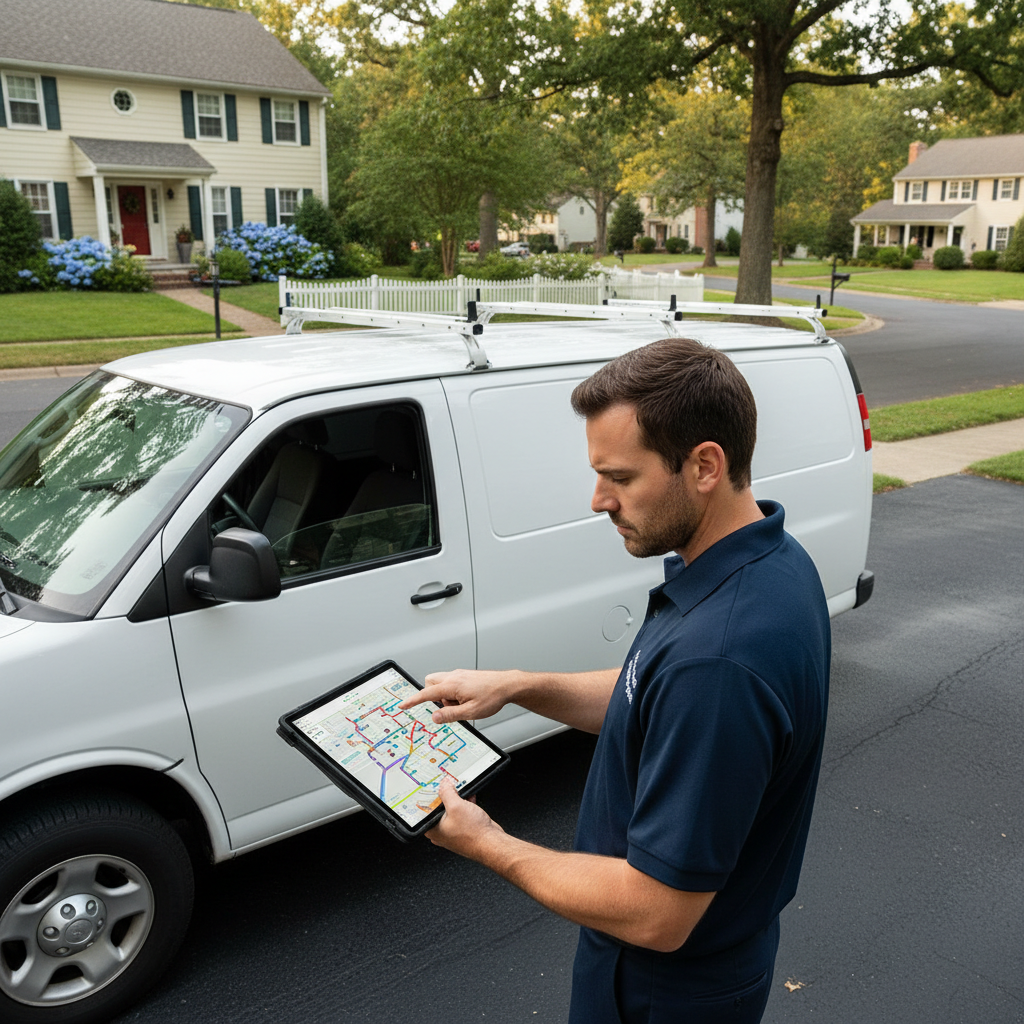
Operators who treat "service area" as a single radius from their office location are leaving money on the table. Effective capacity alignment requires zone-based routing where lead acquisition matches existing customer density and crew deployment patterns.
Solution: Geographic Routing Rules at the Acquisition Layer
You need to build routing constraints into your lead specifications before the lead is generated, not after it arrives in your CRM. This means defining acquisition zones based on current crew assignments, average drive time per zone, and minimum job density thresholds.
Start by mapping your existing customer base by zip code. Identify clusters where you already have high penetration. These zones have lower acquisition costs because your brand recognition is higher, and your routing efficiency is maximized. Prioritize lead generation in these clusters first.
Next, establish a maximum drive time rule for new leads. For residential pest control, the industry benchmark is twelve to fifteen minutes from the previous stop or crew start point. For commercial contracts, you can extend this to twenty-five minutes if ticket size justifies it. These are hard filters, not aspirational targets.
"⭐️ Dolead Expert Tip: Define your lead spec by zip code, not just city or county. A single city can have wildly different drive time profiles depending on traffic patterns and highway access. We deliver leads based on business-rule routing, so your acquisition stays aligned with dispatch efficiency."
Implement a density threshold for activating new zones. Do not acquire leads in a new zip code unless you can generate at least eight to twelve jobs per month in that area. Sparse customer distribution kills routing efficiency and makes retention harder because your technicians visit infrequently.
Finally, use dynamic zone activation. If your summer mosquito season increases crew count by two teams, expand your acquisition zones accordingly. When you scale back to off-season capacity, contract your lead generation footprint to match.
Challenge: Service Type Mismatch and Crew Specialization
Not all pest control jobs are created equal in terms of crew requirements, duration, or margin. A residential quarterly service takes forty-five minutes. A termite inspection and treatment can take three hours. Rodent exclusion work requires different tools, training, and pricing.
If your acquisition strategy delivers fifteen termite leads in one week but your licensed termite specialist is already booked for nine days, you have a bottleneck. You cannot fulfill the work, and the lead ages out or gets redistributed to a competitor.
Crew specialization creates capacity silos. Your generalist residential technicians cannot cover commercial accounts that require pesticide applicator certifications for schools or food service facilities. Your wildlife removal specialist cannot handle bed bug heat treatments. Each service line has its own capacity ceiling.
Solution: Service-Type Throttling and Demand Forecasting
Align your lead generation with service-type capacity by implementing throttle controls based on current backlog and crew availability. This requires integration between your CRM, scheduling system, and acquisition channels.
Build a capacity dashboard that tracks open appointment slots by service type and crew. Update this daily. If your termite crew is at 85% capacity for the next two weeks, reduce or pause termite lead generation until availability opens. This is not "turning off revenue." This is preventing revenue leakage from leads you cannot convert in time.
Use lead specification filters to match service type to crew capacity in real time. For example, if you have excess capacity for rodent control but limited availability for bed bug work, shift your acquisition budget to rodent-specific campaigns. This requires a performance partner who can adjust lead delivery by service category, not a static monthly contract.
"📌 Partner Note: Delivery is instant and routing is business-rule based."
Implement seasonal demand forecasting based on historical data. Mosquito and tick treatments spike in May and June. Rodent exclusion increases in October and November. Termite inspections peak during real estate transaction season. Map these patterns and pre-adjust your acquisition capacity six weeks before demand surges.
For high-margin commercial work, establish a dedicated pipeline separate from residential volume. Commercial pest control has longer sales cycles, requires site visits and proposals, and involves contract negotiations. Do not mix commercial leads into your residential routing logic. They require different handling, different sales processes, and different capacity planning.
Challenge: Appointment Availability and Conversion Speed
Pest control is often an urgent need. A homeowner who sees termite swarms or rodent droppings wants service this week, not three weeks from now.
If your first available appointment is fourteen days out, your close rate drops by 40% or more. The lead either goes cold or converts with a competitor who can respond faster.
Conversion speed is a function of capacity slack. If you are running crews at 95% utilization, you have no buffer for urgent jobs, no room for same-day or next-day service, and no ability to accommodate the homeowner who needs immediate help.
Operators who optimize for maximum utilization are optimizing for the wrong metric. The correct goal is optimal utilization with strategic slack to capture high-intent, time-sensitive demand.
Solution: Capacity Buffers and Urgency-Based Routing
Maintain a 15-20% capacity buffer across your crew schedule specifically for urgent requests and same-week appointments. This buffer is not wasted capacity. It is the mechanism that allows you to close high-intent leads before they shop competitors.
Implement urgency-based lead routing where time-sensitive requests (active infestations, hazard situations, real estate inspections with closing deadlines) are prioritized over routine quarterly services. Your CRM should flag these leads and route them to the nearest crew with availability in the next 48 hours.
"⭐️ Dolead Expert Tip: Urgent pest situations convert at 60-70% if you can offer next-day service, compared to 25-35% for appointments scheduled two weeks out. The capacity buffer is not a cost center; it is a conversion accelerator."
Use dynamic scheduling to compress or expand appointment windows based on lead volume. If you receive eight new termite inspection requests on Monday and your specialist has four open slots this week, compress the inspection window to thirty minutes instead of sixty and book all eight. If lead volume is light, expand the window to provide better service and upsell opportunities.
For non-urgent work (quarterly services, preventive treatments, annual renewals), use scheduled callback protocols rather than immediate booking. Call the lead within two hours to confirm interest, provide pricing, and schedule the appointment for the next available optimal route. This keeps your utilization high without sacrificing conversion.
"📌 Partner Note: We support click-to-call for urgent hazard demand."
Establish off-peak incentives to shift demand into underutilized time slots. Offer a 10% discount for mid-week or early-morning appointments during slow periods. This smooths demand spikes and improves overall crew utilization without overbooking peak windows.
Challenge: Seasonal Demand Swings and Crew Scaling
Pest control is a seasonal business. Demand for mosquito control, tick treatments, and stinging insects peaks in late spring and summer. Rodent exclusion surges in fall. Termite inspections align with real estate transaction volume.
If your lead generation runs at a constant rate year-round but your crew capacity fluctuates, you either waste money on leads you cannot service or miss revenue during peak season.
Fixed acquisition strategies fail in cyclical businesses. A pest control marketing agency operator who spends $4,000 per month on leads in January (when demand is soft and crews are underutilized) and the same $4,000 in May (when demand is high and capacity is constrained) is misallocating capital in both directions.
Solution: Seasonal Capacity Matching and Flexible Acquisition
Map your historical demand curve by service type and month. Identify peak periods, shoulder seasons, and slow months. Use this data to build a variable acquisition budget that scales with capacity and seasonal demand.
During peak season, when you have hired seasonal technicians and expanded crew count, increase your acquisition budget and geographic footprint. This is when you can handle higher lead volume, justify longer drive times for premium jobs, and absorb demand surges without service degradation.
During off-season, contract your acquisition zones to core high-density areas and focus on retention, upsells, and annual contract renewals. Reduce new customer acquisition unless you have identified specific underutilized capacity that needs filling.
Implement pre-season ramp-up by increasing lead generation six to eight weeks before your peak season starts. This allows you to build pipeline, schedule appointments in advance, and enter peak season with a full calendar rather than scrambling to fill slots.
Use crew-level capacity tracking to identify underutilized technicians and target acquisition to their specific service areas and specializations. If one crew is running at 60% utilization while another is at 90%, you have a routing or acquisition problem, not a demand problem.
Challenge: Lead Quality vs. Lead Volume at Capacity Limits
When your crews are running near full capacity, every lead you acquire must meet a higher quality threshold. A low-intent lead that requires multiple follow-ups, long nurture cycles, or eventually does not convert is not just a wasted acquisition cost.
It is an opportunity cost because it displaced a higher-intent lead you could have serviced instead.
Capacity constraints change the ROI equation. When you have excess capacity, you can afford to work lower-intent leads because the marginal cost of a truck roll is low. When capacity is tight, you must prioritize leads with the highest probability of fast conversion and high lifetime value.
Solution: Intent-Based Lead Filtering and Prioritization
Define minimum qualification criteria for leads during high-capacity periods. This includes verifiable contact information, confirmed service address within your priority zones, stated urgency level, and service type match to available crew specialization.
Implement a lead scoring system that prioritizes leads based on:
- 🎯 Urgency: Active infestation or hazard situation scores higher than preventive inquiry.
- 💰 Service type: High-margin services (termite treatment, bed bugs, wildlife removal) score higher than routine quarterly plans.
- 📍 Geographic fit: Leads within existing high-density routes score higher than outlier locations.
- ⚡ Response speed: Leads who answer callback attempts within two hours score higher than those requiring multiple contact attempts.
"⭐️ Dolead Expert Tip: During peak season, set a minimum ticket size threshold for new customer acquisition. If a lead is requesting a $95 one-time treatment and you have limited capacity, prioritize the $450 quarterly contract or the $1,800 termite job instead."
Use dynamic pricing to manage demand when capacity is constrained. Increase pricing for non-urgent work during peak periods. This either improves margin on work you do accept or naturally throttles lower-intent demand without rejecting leads outright.
Establish a waitlist protocol for leads that do not meet immediate capacity or urgency criteria. Rather than losing the lead entirely, offer to schedule service two to three weeks out at a discounted rate. This keeps the lead warm and fills future capacity gaps.
Challenge: CRM Integration and Real-Time Capacity Visibility
Most pest control operators manage leads in one system, dispatch in another, and track capacity manually or not at all. This creates a visibility gap where your acquisition team does not know current crew utilization, your dispatch team does not know how many new leads are in pipeline, and your sales team books appointments without confirming availability.
Disconnected systems create overbooking and missed revenue. You accept a termite inspection for Thursday afternoon without knowing your termite specialist already has six jobs scheduled. You run a weekend promotion for mosquito treatments without checking if your spray technician is available.
Solution: Unified Capacity and Lead Management System
Integrate your CRM, scheduling system, and acquisition channels into a single source of truth for capacity and lead status. This does not require enterprise software. It requires disciplined data hygiene and real-time updates.
Your CRM should display:
- 📊 Current crew utilization by service type and date range.
- 📅 Open appointment slots for the next 14 days by crew and zone.
- 📋 Lead backlog by service type, urgency, and age.
- ⏱️ Conversion velocity from lead receipt to booked appointment.
Set up automated capacity alerts that notify your acquisition team when utilization exceeds 85% for any service type or crew. This triggers throttle protocols before you reach overbooking.
Implement bi-directional feedback loops between your CRM and acquisition partner. When a lead converts and an appointment is booked, that data should flow back to adjust targeting, pacing, and zone prioritization in real time.
Use daily capacity huddles where dispatch, sales, and operations review upcoming appointments, identify gaps, and adjust acquisition priorities. This is a fifteen-minute standup, not a two-hour meeting. The goal is alignment, not analysis paralysis.
The Economics: Yield Per Lead vs. Cost Per Lead
Most pest control operators track Cost Per Lead (CPL) as their primary acquisition metric. This is incomplete. CPL tells you what you paid, but it does not tell you what you earned. The correct metric is Yield Per Lead (YPL), which measures revenue generated per lead acquired, factoring in conversion rate, average ticket size, and lifetime value.
Here is the mathematical breakdown:
Cost Per Lead (CPL) = Total Marketing Spend ÷ Total Leads Acquired
Example: You spend $8,000 per month and acquire 160 leads. Your CPL is $50.
Conversion Rate = Leads Converted to Paying Customers ÷ Total Leads Acquired
Example: 48 of those 160 leads convert. Your conversion rate is 30%.
Average Ticket Size = Total Revenue from Converted Leads ÷ Number of Converted Leads
Example: Those 48 customers generate $21,600 in initial revenue. Your average ticket is $450.
Yield Per Lead (YPL) = (Conversion Rate × Average Ticket Size) - CPL
Example: (0.30 × $450) - $50 = $135 - $50 = $85 net yield per lead acquired.
Now factor in Customer Lifetime Value (LTV). If the average pest control customer stays for 3.2 years at four services per year and an average ticket of $185 per service:
LTV = 3.2 years × 4 services × $185 = $2,368 per customer.
Your True Yield Per Lead becomes:
(Conversion Rate × LTV) - CPL = (0.30 × $2,368) - $50 = $710 - $50 = $660 net yield per lead.
This math reveals why lead quality and conversion speed matter more than CPL optimization. A $50 lead that converts at 30% and generates $2,368 in LTV is worth thirteen times more than a $30 lead that converts at 15% and churns after one service.
Operators who focus exclusively on lowering CPL often sacrifice lead quality, which tanks conversion rate and LTV. The correct strategy is to maximize YPL by improving lead qualification, reducing time-to-contact, and optimizing routing to increase ticket size and retention.
10-Point Operational Audit for Capacity-Aligned Lead Acquisition
Use this audit to identify gaps in your current lead generation and crew capacity alignment:
- 1️⃣ Geographic Routing Rules: Do you have defined acquisition zones with maximum drive time thresholds?
- 2️⃣ Service Type Matching: Can you throttle lead generation by service category (termite, rodent, mosquito, bed bug) based on crew availability?
- 3️⃣ Capacity Dashboard: Do you have real-time visibility into crew utilization by service type and date range?
- 4️⃣ Urgency-Based Routing: Are high-intent, time-sensitive leads prioritized over routine appointments?
- 5️⃣ Capacity Buffer: Do you maintain 15-20% schedule slack for urgent same-week requests?
- 6️⃣ Seasonal Forecasting: Do you adjust lead generation volume six weeks before demand peaks and troughs?
- 7️⃣ Lead Scoring System: Are leads prioritized by urgency, ticket size, geographic fit, and response speed?
- 8️⃣ CRM Integration: Does your scheduling system sync with your CRM to prevent overbooking?
- 9️⃣ Daily Capacity Huddle: Do dispatch, sales, and operations meet daily to align on capacity and lead priorities?
- 🔟 Yield Per Lead Tracking: Do you measure net revenue per lead (YPL) instead of just cost per lead (CPL)?
If you answered "no" to more than three of these questions, your lead generation is misaligned with operational capacity, and you are leaking revenue through overbooking, underutilization, or geographic inefficiency.
Standard Operating Procedures for Lead Follow-Up and CRM Integration
Effective lead management requires documented processes that connect acquisition, sales, and dispatch. Use these SOPs as a starting template:
SOP 1: Lead Intake and Initial Contact
- ⚙️ Step 1: Lead enters CRM with service type, urgency flag, and geographic data.
- ⚙️ Step 2: CRM auto-assigns lead to sales rep based on service specialization and territory.
- ⚙️ Step 3: Sales rep contacts lead within 2 hours (urgent) or 4 hours (routine).
- ⚙️ Step 4: Rep qualifies lead (service type, address, urgency, budget) and checks crew availability.
- ⚙️ Step 5: Rep books appointment or schedules callback if capacity is unavailable.
SOP 2: Appointment Scheduling and Dispatch Sync
- ⚙️ Step 1: Sales rep confirms appointment in CRM with service type, date, time, and address.
- ⚙️ Step 2: CRM syncs appointment to dispatch board and updates crew utilization metrics.
- ⚙️ Step 3: Dispatch reviews daily schedule for routing optimization and identifies conflicts.
- ⚙️ Step 4: Customer receives automated confirmation with technician name, arrival window, and contact info.
- ⚙️ Step 5: Technician receives route sheet with job details, customer notes, and upsell prompts.
SOP 3: Post-Service Follow-Up and Retention
- ⚙️ Step 1: Technician completes service and logs job notes, products used, and upsell opportunities in CRM.
- ⚙️ Step 2: Customer receives automated satisfaction survey within 24 hours.
- ⚙️ Step 3: CRM flags customers for quarterly service reminders, renewal outreach, or referral requests.
- ⚙️ Step 4: Sales rep follows up on upsell opportunities (annual contracts, preventive treatments, add-on services).
- ⚙️ Step 5: Dispatch schedules next service and updates crew routing based on customer retention.
These SOPs ensure that leads are handled consistently, appointments are fulfilled without overbooking, and customers are retained for long-term value.
Why a Lead Generation Partner is the Right Solution for You
Dolead operates as an operational extension of your business, absorbing the marketing risk by delivering validated, exclusive leads on a strict pay-per-lead model.
About the Author
Guillaume Heintz is an operator-grade lead generation expert with decades of experience helping Pest Control professionals scale using performance-based marketing strategies.


.svg)
.svg)
.svg)
.svg)


