Your plumbers are showing up to calls where homeowners are already anchored on the wrong price, expect a free estimate with zero commitment, and treat your technician like a mobile Yelp reviewer. The problem isn't your closing process—it's that the lead arrived pre-loaded with objections your plumbing marketing never addressed. Most operators treat plumbing lead generation solutions as a volume game, but the real leverage is in how the lead understands your business before the first interaction.
This isn't about 'building brand awareness.' It's about structurally engineering the lead's expectations so your dispatch team isn't firefighting objections that should've been neutralized upstream. When a lead enters your CRM pre-framed with the right context—service urgency, warranty positioning, flat-rate transparency—your book rate climbs and your average ticket increases without changing a single word in your sales script.
Challenge: Leads Enter With Zero Context About Your Service Model
The median plumbing call starts with a homeowner who thinks they're calling for a 'free quote' on a single fixture repair. They don't understand flat-rate pricing, diagnostic fees, or why your $89 dispatch charge exists. Your CSR spends the first 90 seconds of the call explaining your business model instead of qualifying urgency.
This is a structural failure, not a training issue. The lead source—whether it's a directory listing, a shared marketplace, or a generic ad—delivered zero context about how your company operates. The homeowner is comparing you to the handyman they found on Craigslist who quoted $75 over text.
Solution: Build Pre-Qualification Into Your Lead Capture Flow
Your plumbing marketing funnel should function as a context delivery system. Every touchpoint before the phone rings must reinforce three operational truths: you charge for expertise, you operate on appointments (not same-day chaos), and your pricing reflects warranty-backed work.
Start with your landing page copy. Replace 'Get a Free Estimate' with 'Book Your Diagnostic Appointment.' The word 'diagnostic' immediately reframes the expectation. You're not guessing—you're inspecting, testing, and providing options.
Add a pre-call FAQ section directly on the conversion page. Address the diagnostic fee, your scheduling windows, and what happens after the technician arrives. This isn't educational content for SEO—it's friction elimination. The homeowner who reads 'We charge $89 for the diagnostic, waived if you proceed with the repair' and still submits the form is a higher-intent lead than someone who expects everything for free.
Use multi-step forms to segment urgency. Ask 'When do you need this fixed?' with options: 'Emergency (today)', 'This week', 'Next 2 weeks', 'Just researching.' The emergency tier gets routed to your premium pricing team. The 'just researching' tier gets nurtured via email, not burned through high-cost dispatch.
"⭐️ Dolead Expert Tip: Pre-qualification doesn't reduce volume—it increases addressable volume. When you filter out tire-kickers before they hit your CRM, your CSRs spend more time on leads who actually match your capacity and pricing model. This directly impacts your revenue per CSR hour."
Challenge: Price Objections Happen Because You Didn't Frame Value First
Your technician arrives, diagnoses a slab leak, quotes $2,400 for the repair with a warranty, and the homeowner says 'I got a quote for $800 from another guy.' This isn't a negotiation problem—it's a messaging sequence failure. The lead never learned what 'warranty-backed' or 'licensed and insured' means in operational terms.
The $800 quote is from an unlicensed operator with no insurance, no permit process, and no callback if the leak returns in six months. But your marketing never explained why those things cost money and protect the homeowner. You're expecting the technician to deliver a 10-minute education session on risk, which kills your close rate.
Solution: Pre-Frame the Cost-of-Ownership Model Before the Appointment
Your confirmation email (sent immediately after booking) should include a 2-minute explainer video or a PDF titled 'What to Expect from Your Plumbing Diagnostic.' Inside, you walk through:
- ✅ Why licensed contractors cost more: permits, insurance, warranty labor
- ✅ How flat-rate pricing works: no surprise hourly overruns
- ✅ What's included in your repair: parts, labor, follow-up
- ✅ The real cost of 'cheap' repairs: callbacks, code violations, resale impact
This isn't a sales pitch. It's operational education that reframes the decision from 'cheapest quote' to 'best long-term outcome.' The homeowner who watches this before your truck arrives is already anchored on value, not price.
Add a live chat widget to your booking confirmation page with a scripted prompt: 'Have questions about flat-rate pricing or our warranty? Chat with us now.' The homeowners who engage are self-identifying as high-concern leads. Your CSR can address pricing fears before the appointment, reducing no-shows and same-day cancellations.
For high-ticket services (repiping, sewer line replacement, water heater installs), send a case study email 24 hours before the appointment. Show a similar job, the scope, the timeline, and the outcome. Example: 'Here's how we replaced a slab leak in 6 hours with zero drywall damage.' This primes the lead to expect your pricing structure and builds confidence in your process.
"📌 Partner Note: Compliance is built into our validation rules so you don't buy risk."
Challenge: Your Leads Don't Understand Urgency vs. Convenience
A homeowner calls about a 'slow drain' and wants an appointment 'sometime next week when it's convenient.' Your dispatcher books it, the technician arrives, and discovers a partially collapsed sewer line that needs immediate excavation. The homeowner balks because they weren't mentally prepared for a $6,000 decision. Your marketing positioned this as a routine service call, not a potential emergency.
This mismatch happens because your lead capture doesn't differentiate between maintenance requests and failure-mode situations. You're routing every inquiry through the same 'schedule a visit' funnel, which trains homeowners to expect low-stakes interactions.
Solution: Segment Leads by Problem Severity at Intake
Your intake form (phone script or web form) must include a symptom severity matrix. For drains: 'Slow but functional' vs. 'Completely blocked' vs. 'Backing up into other fixtures.' Each tier triggers a different response:
- 🟢 Slow but functional: Standard scheduling, maintenance positioning, no urgency language.
- 🟡 Completely blocked: Same-day or next-day priority, 'This will get worse' messaging, higher pricing tier.
- 🔴 Backing up: Emergency dispatch, health hazard framing, premium pricing with no apology.
When you route a 'backing up into the shower' lead to your emergency team, your CSR says: 'This is a health and safety issue. We can have someone there in 2 hours. The emergency rate is $150 for the diagnostic, and most sewer backups run between $400 and $2,000 depending on the blockage location. Does that work?'
You've just pre-closed the price objection. The homeowner who says yes is expecting a significant repair cost. The one who says 'I'll wait' is self-selecting out, which saves you a wasted truck roll.
For non-emergency leads, your confirmation messaging should still plant urgency seeds. Example: 'Slow drains usually indicate partial blockages that worsen over time. If you notice any changes before your appointment (slower flow, gurgling sounds), call us immediately for priority scheduling.' This educates the homeowner to recognize escalation and primes them to accept a bigger scope if needed.
Challenge: Trust Signals Are Missing Until the Technician Arrives
Your lead sees your ad, clicks, fills out a form, and receives a generic 'We'll call you soon' confirmation. They have no idea if you're a 2-truck operation or a 40-truck fleet, whether you've been in business 6 months or 20 years, or if you're licensed. The trust gap between 'I submitted a form' and 'A truck is in my driveway' is where most leads get cold feet.
They Google your company, see mixed reviews or no reviews, check your competitors, and start second-guessing. By the time your CSR calls, the lead is already skeptical or has booked with someone else who had better social proof visible at the point of conversion.
Solution: Inject Trust Signals Into Every Pre-Appointment Touchpoint
Your confirmation page (immediately after form submission) should display:
- 🏆 Years in business and license number (with a link to verify on the state registry)
- ⭐ Live review feed from Google or Yelp (embedded widget, not a static screenshot)
- 👨🔧 Technician profiles with photos, certifications, and tenure ('Your diagnostic will be performed by a master plumber with 12+ years of experience')
- 🛡️ Insurance and bonding details with real policy numbers (this signals operational maturity)
Your confirmation email should include a personal video from the owner or lead plumber. Script: 'Hi, I'm [Name], owner of [Company]. Thanks for trusting us with your plumbing issue. Here's what happens next: our team will call within 15 minutes to confirm your appointment, and we'll send you the profile of the technician who'll be handling your job. We've been serving [City] since [Year], and we back every repair with a [X-year] warranty. Looking forward to solving this for you.'
This 30-second video does more for trust than a thousand words of 'About Us' copy. It humanizes your operation and gives the lead a face to associate with your brand.
For text-based confirmation messages (SMS), include a Google Maps link to your shop location and your real-time dispatcher phone number. Example: 'Your appointment is confirmed for [Date/Time]. Your technician is [Name], license #[Number]. Our shop is located at [Address - Google Maps link]. Questions? Text or call [Direct Line].'
"⭐️ Dolead Expert Tip: Leads convert faster when they can verify your physical presence. A Google Maps link to a real commercial address beats a PO Box or residential listing every time. If you operate from home, list your service area with a 'fully mobile, locally owned' message instead. Trust is operational, not aspirational."
Challenge: Your Follow-Up Messaging Feels Like Spam, Not Service
You send a 'We're still here if you need us!' email to unconverted leads, and it gets ignored. The lead has moved on, booked with a competitor, or decided to live with the problem. Your nurture sequence has zero operational value because it's not tied to their actual decision-making timeline.
Most plumbing leads operate in one of three windows: immediate (today/tomorrow), short-term (this week), or deferred (budgeting for next month/quarter). If you're sending the same email cadence to all three, you're wasting sends and training leads to ignore you.
Solution: Map Nurture Sequences to Decision Windows
Segment your CRM by lead urgency tier (captured at intake). Your sequences should reflect the natural decision cycle for each tier:
Immediate Tier (Emergency/Today):
- ⚡ No email nurture—100% phone and SMS.
- ⚡ Text at +15 minutes if no answer: 'We have a truck available in your area. Reply YES to confirm or call [Number].'
- ⚡ Second text at +1 hour: 'Still need emergency plumbing? Last availability today at [Time]. Reply to hold the slot.'
- ⚡ After 4 hours with no response, move to 'lost - emergency resolved elsewhere.'
Short-Term Tier (This Week):
- 📅 Day 0: Confirmation email with video, trust signals, and appointment details.
- 📅 Day 1: SMS reminder with technician profile and arrival window.
- 📅 Day 2: Email with case study relevant to their issue ('How we fixed a slab leak in 6 hours').
- 📅 Day 3: Pre-appointment call to confirm and surface any new questions.
- 📅 Post-appointment: Feedback request within 2 hours, then warranty reminder at +30 days.
Deferred Tier (Budgeting/Researching):
- 📚 Week 0: Educational email on 'Cost of delaying [their specific issue]' with real failure examples.
- 📚 Week 1: Financing options overview (if you offer it) with approval calculator.
- 📚 Week 2: Seasonal incentive or slow-season discount (if applicable).
- 📚 Week 4: 'Still planning your project?' check-in with updated availability.
- 📚 Month 3: Archive to low-priority list, quarterly re-engagement only.
Each tier gets content mapped to their mental state. The emergency lead doesn't need education—they need availability. The researcher doesn't need urgency—they need cost justification and trust building.
"📌 Partner Note: We keep the process auditable and safe."
Challenge: Your Technicians Aren't Equipped to Reinforce the Pre-Frame
You've done everything right—your lead arrives pre-qualified, educated on pricing, and expecting a professional experience. Then your technician shows up in an unmarked van, doesn't mention the warranty, and quotes a price without explaining what's included. The last-mile experience contradicts everything your marketing promised, and the lead ghosts you.
This is a handoff failure. Your CSRs and marketing built a high-trust expectation, but your field team doesn't have the scripts or tools to deliver on it. The disconnect kills your close rate even when the lead is perfectly qualified.
Solution: Create a Technician Pre-Call Briefing Protocol
Before every appointment, your dispatcher must send the technician a lead briefing via your CRM or dispatch app. Required fields:
- 📋 Lead source (so the tech knows if this is a high-intent exclusive lead or a shared marketplace inquiry)
- 📋 Problem description and urgency tier (emergency, standard, maintenance)
- 📋 Pre-qualification notes (homeowner was informed about diagnostic fee, flat-rate pricing, etc.)
- 📋 Key objections surfaced during booking ('Concerned about cost,' 'Comparing quotes,' 'Just wants it fixed fast')
- 📋 Trust signals delivered (homeowner watched the explainer video, received the warranty guide, etc.)
The technician reads this before knocking on the door. Their opening script reinforces the pre-frame: 'Hi, I'm [Name], the master plumber you were assigned. I know [CSR Name] walked you through our diagnostic process and flat-rate pricing. I'm here to inspect the [issue], test everything, and give you a few options with upfront pricing. The diagnostic fee is $89, which you already approved. Let's take a look.'
This callback to prior messaging eliminates the 'Who are you and what do you charge?' reset that kills momentum. The homeowner feels continuity, not confusion.
Equip your technicians with a tablet-based pricing tool that displays:
- 💎 Good/Better/Best options with clear feature differences (not just price tiers)
- 💎 Warranty terms for each option (1-year parts vs. 5-year labor and parts)
- 💎 Financing calculator (if applicable) showing monthly payment for each tier
- 💎 Visual proof of the issue (photos taken during diagnostic, annotated to show the problem)
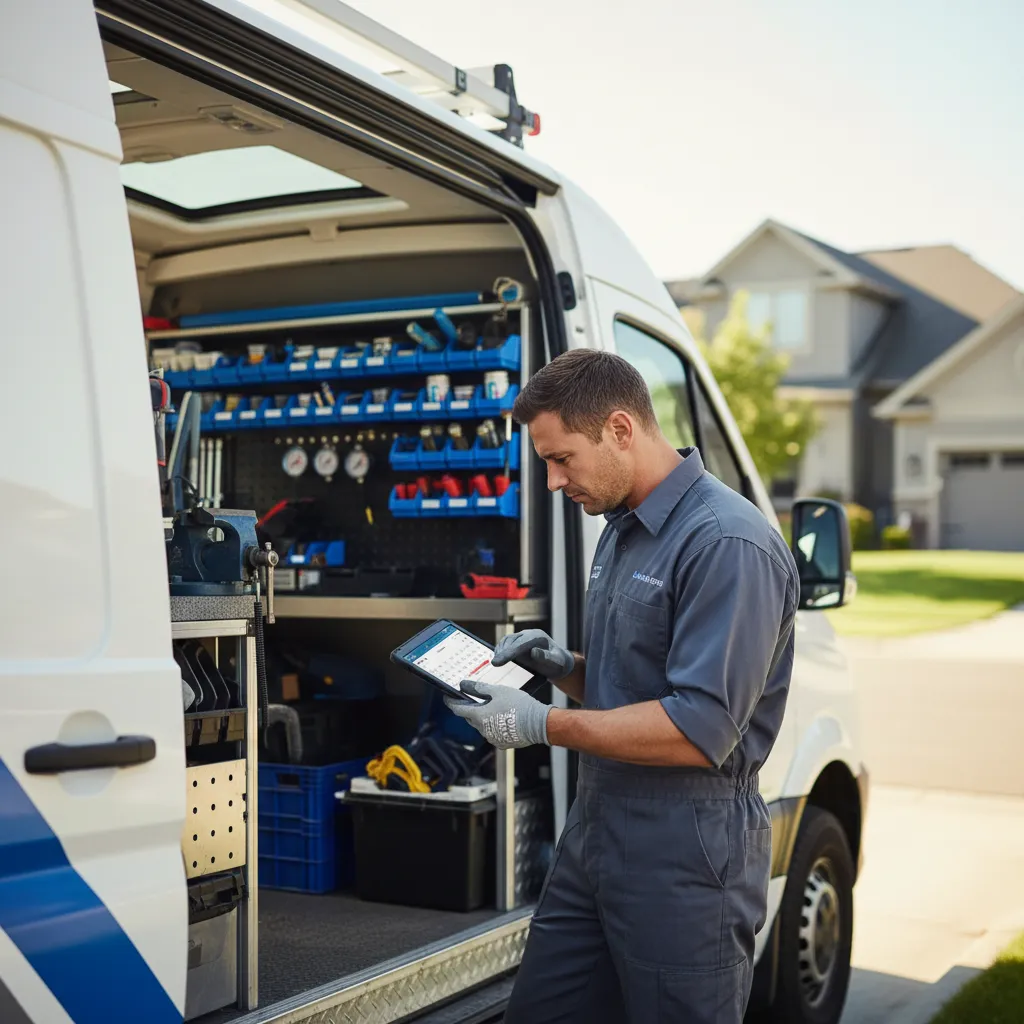
The technician walks the homeowner through the tablet, not a handwritten estimate on a clipboard. This reinforces the 'professional operation' positioning your marketing established and makes the quote feel non-negotiable (because it's system-generated, not subjective).
Challenge: You're Not Tracking Which Pre-Frame Elements Actually Move Metrics
You've added explainer videos, trust badges, multi-step forms, and urgency segmentation. But you have no idea which elements are increasing your book rate, reducing cancellations, or improving average ticket. You're operating on assumptions instead of closed-loop feedback.
Most plumbing operators track lead volume and conversion rate, but they don't measure pre-frame engagement. You don't know how many leads watched the video, read the warranty guide, or interacted with the chat widget before booking. Without this data, you can't optimize the system.
Solution: Instrument Every Pre-Appointment Touchpoint
Your CRM should log engagement events for every lead:
- 📊 Confirmation page dwell time (did they stay long enough to read the trust signals?)
- 📊 Video play rate and completion percentage (did they watch the explainer?)
- 📊 PDF downloads (warranty guide, financing options, case study)
- 📊 Chat interactions (did they ask about pricing or scheduling?)
- 📊 SMS reply rate (are they engaging with appointment reminders?)
- 📊 Email open and click rates (are they reading the pre-appointment content?)
Tag each lead with their engagement score (low, medium, high) based on these interactions. Then run a monthly analysis:
- 🎯 Book rate by engagement tier: Do high-engagement leads convert at a higher rate?
- 🎯 Average ticket by engagement tier: Are educated leads buying bigger solutions?
- 🎯 Cancellation rate by engagement tier: Are pre-framed leads more reliable?
- 🎯 Objection frequency by engagement tier: Do CSRs spend less time explaining pricing to high-engagement leads?
If you find that leads who watch the explainer video have a 23% higher book rate and a $340 higher average ticket, you now have a business case to make that video mandatory (gated content before booking confirmation). If leads who download the warranty guide have a 40% lower cancellation rate, you prioritize that asset in your confirmation sequence.
Your dispatch team should also log first-call objections in the CRM. Categories:
- 🚩 Price concern (diagnostic fee, flat-rate confusion)
- 🚩 Timeline concern (wants faster/slower service)
- 🚩 Trust concern (wants to verify license, insurance, reviews)
- 🚩 Scope concern (doesn't understand what's included)
If 60% of your leads are hitting the CSR with diagnostic fee objections, your landing page messaging failed. You adjust the copy to address it upfront. If 40% are asking about financing, you add a financing calculator to the confirmation page.
This closed-loop optimization turns your pre-frame system from a guess into a repeatable growth lever.
"⭐️ Dolead Expert Tip: The highest-performing plumbing operations treat their CRM like a flight data recorder. Every objection, every no-show, every cancellation gets logged with a reason code. After 90 days, the patterns are obvious—and fixable. This is how you systematically improve yield per lead."
10-Point Operational Audit for Plumbing Marketing Pre-Framing
Use this checklist to evaluate your current lead intake and pre-framing process. Each item should be scored as Yes (implemented and tracked), Partial (exists but not optimized), or No (not implemented). A score below 7/10 indicates significant revenue leakage from poor lead conditioning.
- 1️⃣ Landing Page Value Framing: Does your primary conversion page explicitly mention diagnostic fees, flat-rate pricing, and warranty terms before form submission?
- 2️⃣ Multi-Step Urgency Segmentation: Do you capture urgency tier (emergency/standard/deferred) in your intake form and route leads accordingly?
- 3️⃣ Confirmation Page Trust Signals: Does your post-submission confirmation page display license numbers, review widgets, technician profiles, and insurance details?
- 4️⃣ Explainer Video Deployment: Do you send a 2-3 minute video explaining your service model, pricing structure, and warranty in the first confirmation email?
- 5️⃣ Pre-Appointment Case Study Delivery: For high-ticket services, do you send relevant case studies 24-48 hours before the appointment?
- 6️⃣ Technician Lead Briefing Protocol: Does every technician receive a CRM-generated briefing with lead source, objections surfaced, and pre-qualification status before arrival?
- 7️⃣ Tablet-Based Pricing Presentation: Do your technicians use digital tools (not handwritten estimates) to present Good/Better/Best options with visual proof?
- 8️⃣ Engagement Event Tracking: Does your CRM log video views, PDF downloads, chat interactions, and SMS replies for every lead?
- 9️⃣ Objection Reason Code Logging: Do your CSRs and dispatchers log the primary objection type for every unconverted or cancelled lead?
- 🔟 Tiered Nurture Sequences: Do you run separate follow-up sequences for emergency, short-term, and deferred leads based on their stated decision timeline?
For each No or Partial answer, calculate the operational cost. If you're processing 200 leads per month and your book rate is 35%, fixing just three of these gaps could push you to 45-50% book rate—adding 20-30 additional jobs per month from the same lead volume. That's pure margin expansion with zero increase in acquisition cost.
The Economics of Pre-Framing: Yield per Lead vs. Cost per Lead
Most plumbing operators obsess over Cost per Lead (CPL) while ignoring Yield per Lead (YPL). CPL measures what you paid to acquire the lead. YPL measures the revenue you extracted from it. A $50 CPL that generates $2,000 in revenue (YPL of $2,000) crushes a $20 CPL that generates $400 (YPL of $400).
Pre-framing directly increases YPL by improving three conversion stages:
- 💰 Inquiry-to-Appointment Rate: The percentage of leads that book an appointment after initial contact.
- 💰 Appointment-to-Close Rate: The percentage of booked appointments that result in a paid job.
- 💰 Average Ticket Size: The revenue per closed job, influenced by upsell acceptance and service tier selection.
Baseline Math (No Pre-Framing):
- • 200 leads per month at $40 CPL = $8,000 acquisition cost
- • 35% inquiry-to-appointment rate = 70 appointments
- • 50% appointment-to-close rate = 35 closed jobs
- • $600 average ticket = $21,000 revenue
- • YPL = $21,000 ÷ 200 = $105 per lead
- • Net margin (assuming 40% operating cost): $8,400 - $8,000 = $400 profit
Optimized Math (With Pre-Framing):
- • Same 200 leads at $40 CPL = $8,000 acquisition cost
- • 48% inquiry-to-appointment rate (+13 pts) = 96 appointments
- • 62% appointment-to-close rate (+12 pts) = 59 closed jobs
- • $780 average ticket (+$180 from better tier selection) = $46,020 revenue
- • YPL = $46,020 ÷ 200 = $230 per lead
- • Net margin (40% operating cost): $18,408 - $8,000 = $10,408 profit
Pre-framing increased profit by $10,008 per month ($120,096 annually) without adding a single lead. The CPL stayed flat. The difference is pure yield improvement from better lead conditioning.
This is why high-growth operators focus on revenue per lead metrics, not vanity volume. A 200-lead month that generates $46,000 beats a 300-lead month that generates $31,500. Pre-framing lets you extract more from less, which scales your operation without overwhelming your dispatch capacity.
Operator SOPs: Lead Follow-Up and CRM Integration Protocols
Pre-framing only works if your team executes the handoff sequences consistently. Here are the non-negotiable SOPs for CSRs, dispatchers, and technicians:
CSR SOP: First-Contact Protocol
- ✅ Answer within 3 rings or 15 seconds. Every additional ring drops your contact rate by 8%.
- ✅ Use the lead's name immediately. 'Hi [Name], this is [Your Name] from [Company]. I see you requested help with [specific issue from form]. Let's get this handled for you.'
- ✅ Reference prior messaging. 'You should've received our confirmation email with the diagnostic fee details—did that come through okay?'
- ✅ Qualify urgency first. 'On a scale of 1-10, how urgent is this? Is it affecting your ability to use your [kitchen/bathroom/etc.]?'
- ✅ Confirm pricing expectations. 'Just to confirm, our diagnostic fee is $89, which you saw in the booking confirmation. If we proceed with the repair, that fee is waived. Does that work for your budget?'
- ✅ Book the appointment in CRM before ending the call. Send SMS confirmation immediately with technician details and arrival window.
Dispatcher SOP: Pre-Appointment Technician Briefing
- ✅ Generate lead brief 2 hours before appointment. Include: lead source, urgency tier, problem description, objections surfaced, and engagement score (video watched, PDF downloaded, etc.).
- ✅ Flag high-ticket potential. If the issue description includes keywords like 'slab leak,' 'repipe,' 'sewer line,' or 'water heater,' alert the technician to prepare for a multi-option quote.
- ✅ Send homeowner reminder SMS 1 hour before arrival. 'Your plumber [Name] will arrive between [Time Window]. He's a licensed master plumber with 12+ years of experience. Reply with any questions.'
- ✅ Monitor for no-answers. If the homeowner doesn't respond to the 1-hour reminder, call to confirm they're still available. This cuts no-show rates by 30%.
Technician SOP: On-Site Pre-Frame Reinforcement
- ✅ Read the lead brief before knocking. Know the homeowner's name, the problem, and what messaging they've already received.
- ✅ Open with continuity language. 'Hi [Name], I'm [Technician Name]. [CSR Name] walked you through our diagnostic process, so you know I'm here to inspect, test, and give you a few options. Let's take a look.'
- ✅ Perform diagnostic with the homeowner present. Narrate what you're finding in real-time. 'I'm checking the water pressure at this fixture... okay, it's 40 PSI, which is below code. That's likely causing your issues.'
- ✅ Present options on tablet, not clipboard. Show Good/Better/Best with warranty terms, financing (if applicable), and visual proof (photos of the issue).
- ✅ Reference pre-framing assets. 'You should've received our video about flat-rate pricing. This is exactly how it works—these are your three options, all priced upfront, no hourly surprises.'
- ✅ Log objections in CRM before leaving. If the homeowner declines, record the reason: price, timeline, wants second opinion, DIY attempt, etc. This feeds your optimization loop.
The Operational Playbook: Pre-Framing as a Capacity Multiplier
Pre-framing isn't a marketing tactic—it's a capacity management strategy. Every lead that enters your CRM pre-qualified, pre-educated, and pre-sold on your process reduces the time your CSRs spend on objection handling and your technicians spend on re-education. That time savings compounds across your entire operation.
Here's the math: If your CSR spends an average of 4 minutes per lead explaining your diagnostic fee, flat-rate pricing, and service model, and you process 200 leads per month, that's 800 minutes (13.3 hours) of non-revenue labor. If pre-framing cuts that to 90 seconds per lead, you've reclaimed 8.3 hours per month of CSR capacity—enough to handle 50+ additional leads without hiring.
On the field side: If your technician spends 8 minutes per call re-explaining why licensed work costs more than unlicensed work, and you run 150 appointments per month, that's 1,200 minutes (20 hours) of non-revenue time. If pre-framing reduces that to 2 minutes per call, you've unlocked 15 hours of billable capacity per month—equivalent to 12-15 additional jobs at your current service speed.
This is why high-growth plumbing operations treat pre-framing as an operational efficiency lever, not a marketing project. The ROI isn't measured in 'brand perception'—it's measured in calls handled per CSR, jobs completed per technician, and revenue per lead.
Your playbook:
- 1️⃣ Audit your current lead intake flow. Identify every touchpoint between form submission and appointment completion. Flag where objections surface most frequently.
- 2️⃣ Map objections to messaging gaps. If price objections dominate your CSR calls, your landing page and confirmation sequence failed to frame value. If urgency confusion dominates, your intake form isn't segmenting severity.
- 3️⃣ Build your pre-frame asset library. Explainer videos, warranty guides, case studies, technician profiles, financing calculators. These aren't 'nice to haves'—they're objection pre-emption tools.
- 4️⃣ Instrument engagement tracking. Log which leads interact with which assets, then correlate engagement to book rate, average ticket, and cancellation rate. Double down on what moves metrics.
- 5️⃣ Train your team to reinforce, not reset. Your CSRs and technicians must reference the pre-frame messaging ('As you saw in the video...' / 'Like [CSR Name] mentioned...'). Continuity builds trust. Resets destroy it.
- 6️⃣ Iterate based on closed-loop feedback. Review objection logs monthly. If new objections emerge, update your pre-frame content. If engagement drops, test new formats (video vs. text, long vs. short).
The operators who execute this system see 15-30% increases in book rate within 90 days and 10-20% increases in average ticket within 6 months. Not because they changed their pricing or hired better technicians—because they engineered the lead's expectations before the first human interaction.
This is plumbing marketing at the operational level. It's not about 'getting your name out there.' It's about pre-loading every lead with the context your team needs to close efficiently. When your marketing does the objection handling, your people can focus on service delivery and upsell execution. That's how you scale without chaos.
Why a Lead Generation Partner Is the Right Solution for You
Dolead operates as an operational extension of your business, absorbing the marketing risk by delivering validated, exclusive leads on a strict pay-per-lead model.
About the Author
Guillaume Heintz is an operator-grade lead generation expert with decades of experience helping Plumbing professionals scale using performance-based marketing strategies.


.svg)
.svg)
.svg)
.svg)


