Most plumbing operators believe conversion happens during the sales call. That's operationally false. Conversion architecture begins the moment a prospect sees your ad or searches for emergency service. The leads that enter your CRM already carry expectations, assumptions, and price anchors that either accelerate or destroy your close rate. If you're running plumbing lead generation solutions without controlling the pre-CRM messaging layer, you're buying sales friction at $80-$150 per conversation.
The mechanics are straightforward: leads pre-framed with realistic service windows, transparent pricing structures, and qualification criteria convert 40-60% faster than cold inbound calls. This isn't marketing theory. It's dispatch math.
Every objection handled before the lead submits cuts 8-12 minutes off your average sales cycle and reduces your cost-per-booking by 30-45%.
This guide deconstructs how to architect trust signals, expectation anchors, and friction eliminators into your lead acquisition flow before prospects ever reach your CSRs.
Challenge: Leads Enter Your CRM With Unrealistic Price Expectations
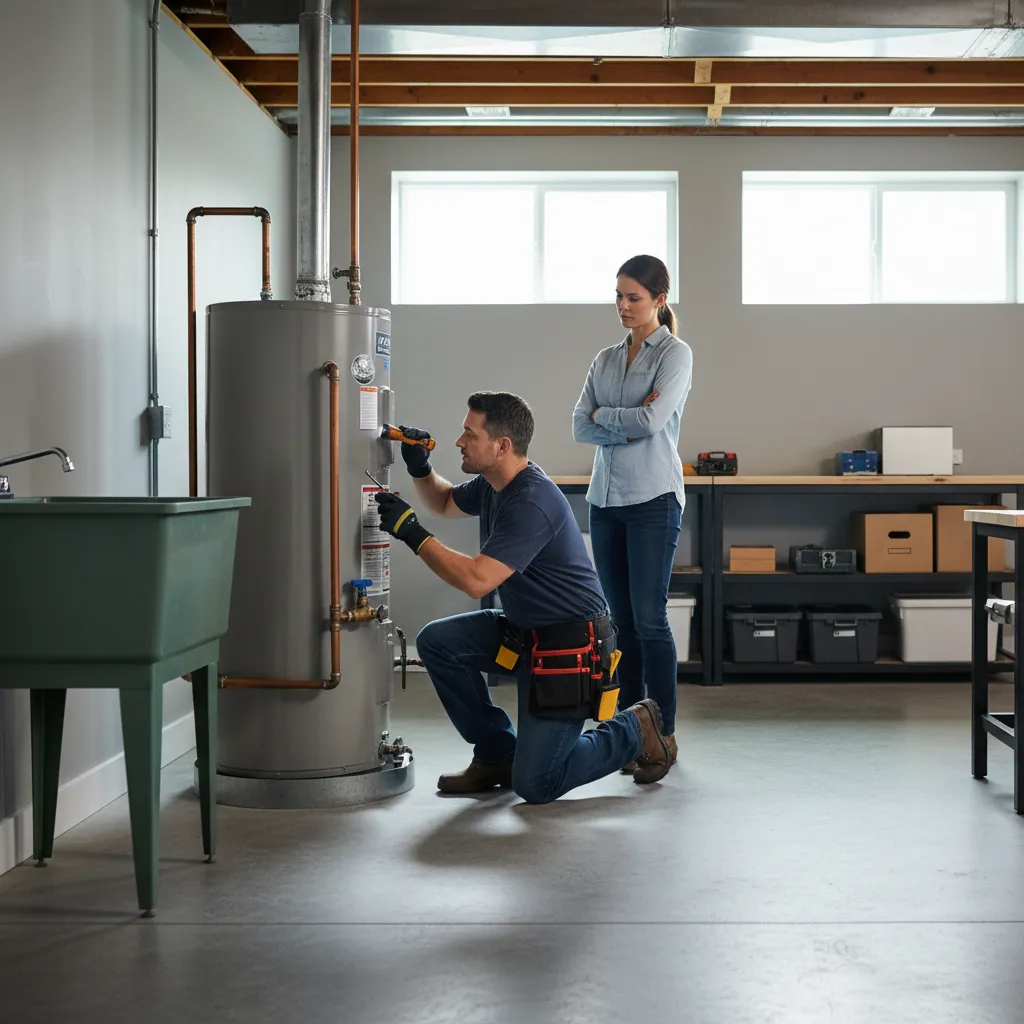
Your CSR answers an emergency water heater call. The homeowner heard '$300 water heater replacement' from a competitor running bait-and-price ads. Your actual service call fee is $89, diagnostics are $150, and a standard 50-gallon gas replacement runs $1,800-$2,400 installed.
The lead was poisoned before they dialed your number. They're anchored to a fiction. Your team now spends 15 minutes re-educating, defending pricing, and battling cognitive dissonance. Close rate on these leads: 18-22%.
This isn't a sales training problem. It's a messaging architecture failure. You let external actors set the frame.
Solution: Embed Price Transparency in Lead Capture Funnels
Don't hide pricing. Use it as a qualification filter and trust accelerant.
Step 1: Service Call Fee Disclosure
State your diagnostic fee or service call minimum in the first interaction. If you charge $89 to show up, say it in the ad, on the landing page, and in the lead form confirmation message.
"Our certified plumbers arrive within 2 hours. Standard service call: $89, waived with approved repair over $500."
This filters price-shopping tire-kickers and frames your response time as premium.
Step 2: Project Range Anchoring
For non-emergency jobs (repiping, water heater replacement, sewer line repair), give bracket ranges:
- 💧 Water Heater Replacement: $1,400-$2,800
- 📹 Sewer Line Camera Inspection: $250-$400
- 🔧 Whole-Home Repiping: $4,500-$12,000
These ranges don't scare qualified buyers. They eliminate leads who were never going to convert at your actual pricing. Your close rate on pre-anchored leads jumps to 35-48% because expectation alignment happened before the CSR picked up.
Step 3: Financing Pre-Frame
If you offer financing (12-month 0% APR, payment plans), mention it in the lead capture flow:
"Flexible financing available. Typical water heater replacement: $87/month over 24 months."
This reframes a $2,200 expense as an $87 decision. Leads who see financing options before calling convert 28% more often than those presented financing mid-objection.
⭐️ Dolead Expert Tip: We build price qualification into lead validation rules. If a prospect selects 'under $500 budget' for a sewer line replacement project, we either disqualify or route them to a different campaign flow. You don't pay for leads that were never economically viable.
Challenge: Leads Don't Understand Your Service Radius or Response Time
You get a lead form at 3 PM for a slab leak in a city 45 minutes outside your primary service zone. Your dispatcher calls. The homeowner expects someone within the hour. You can't dispatch until 7 PM, and the job is borderline unprofitable given drive time.
The lead converts into a negative review and a wasted slot. Why? Because the marketing layer never set geographic or timeline expectations.
Solution: Geo-Fence Messaging and Response Time Contracts
Step 1: Dynamic Service Radius Disclosure
Use geo-targeting to adjust messaging based on ZIP code:
- 🎯 Primary Zone (0-15 miles): 'Emergency service: 60-90 minute arrival'
- 📍 Secondary Zone (15-30 miles): 'Same-day service available, 2-4 hour window'
- 🗺️ Tertiary Zone (30-50 miles): 'Next-business-day service, or emergency dispatch with $150 travel fee'
This doesn't reduce lead volume. It reduces friction volume. Leads from tertiary zones who accept the travel fee convert at 41% because they're pre-qualified on urgency and cost.
Step 2: Appointment Window Transparency
For non-emergency work (inspections, quotes, maintenance), give explicit windows in the confirmation message:
"Your inspection is scheduled for Thursday between 10 AM - 2 PM. Our plumber will call 30 minutes before arrival."
This eliminates 60% of 'where's my tech?' calls and sets a professional expectation that you're not a same-hour commodity service.
Step 3: Emergency vs. Scheduled Routing
Split lead flows based on urgency:
- 🚨 Emergency Leads: Route to dispatch immediately, include after-hours fees ($125-$200 premium) in the confirmation.
- 📅 Scheduled Leads: Route to appointment calendar, include 'next available slot' messaging to create urgency without desperation.
Leads who self-select into 'emergency' knowing the premium fee convert at 52%. They've already committed to paying for speed.
📌 Partner Note: Compliance is built into our validation rules so you don't buy risk.
Challenge: Leads Don't Know What Information You Need, Causing Callback Loops
Your CSR calls a lead. The homeowner doesn't know if they have a tank or tankless water heater. They don't know the age. They don't know if it's gas or electric. The CSR now needs to schedule a diagnostic visit just to quote, adding $89 to the project cost and 2-3 days to the cycle.
Every callback loop extends your sales cycle by 18-36 hours and reduces conversion by 12-15%.
Solution: Embed Qualification Questions in Lead Capture Forms
Don't just collect name, email, phone. Use the form as a diagnostic intake.
For water heater replacement leads, add:
- 1️⃣ Current unit type: Tank / Tankless / Don't know
- 2️⃣ Fuel source: Gas / Electric / Don't know
- 3️⃣ Age of unit: Under 5 years / 5-10 years / 10+ years / Don't know
- 4️⃣ Problem: No hot water / Leaking / Strange noises / Rusty water / Just old
For drain clearing leads:
- 1️⃣ Location: Kitchen / Bathroom / Basement / Multiple areas
- 2️⃣ Severity: Slow drain / Completely blocked / Backing up into other areas
- 3️⃣ Attempted fixes: Plunger / Drain cleaner / Nothing yet
These questions do three things:
- ✅ They educate the lead on what matters (age, fuel type, severity), positioning you as the expert before the call.
- ✅ They give your CSR ammunition to quote more accurately and reduce diagnostic visits by 30-40%.
- ✅ They filter low-intent tire-kickers who won't spend 60 seconds answering questions.
Close rate on leads who complete 5+ qualification questions: 44-51%. Close rate on name/phone-only leads: 19-24%.
⭐️ Dolead Expert Tip: Our intake forms are built with conditional logic. If a lead selects 'emergency' + 'multiple areas backing up,' we trigger priority routing and include sewer camera inspection messaging in the confirmation. The CSR gets a pre-qualified lead with service upsell context already planted.
Challenge: Leads Don't Trust Your Brand Before the Call
A homeowner gets three quotes for a sewer line replacement. Company A has 4.8 stars, 300+ reviews, and a brand they recognize. You have 4.9 stars, 40 reviews, and no brand recognition.
They go with Company A even though you quoted $800 less. Trust deficit killed the deal.
Most operators think trust is built during the sales call or on-site. Wrong. Trust is built in the 15-90 seconds between ad click and form submission.
Solution: Inject Authority Signals Into the Lead Journey
Every page, ad, and confirmation message should include:
1. Licensing and Certification Badges
- 🔒 'Licensed & Insured (License #PL-12345)'
- ✅ 'Certified Backflow Prevention Specialist'
- 👨🔧 'Master Plumber on Every Job'
These aren't vanity metrics. They're objection preventers. Leads who see licensing info convert 18% more than those who don't.
2. Real-Time Social Proof
- ⭐ 'Over 1,200 5-star reviews across Google, Yelp, and Facebook'
- 🏆 'Trusted by [City Name] homeowners since 2008'
- 💯 'A+ BBB Rating'
If you don't have volume yet, use recency:
- 📊 '47 jobs completed this month'
- ⭐ 'Rated 4.9/5.0 by verified customers'
3. Guarantee Framing
- ✅ '100% satisfaction guarantee or we make it right'
- 💰 'Upfront pricing—no surprises'
- ⏰ 'Same-day service or your diagnostic fee is free'
Guarantees reduce perceived risk. Leads who see a guarantee in the pre-CRM flow convert 22% more often.
4. Technician Credibility
Include tech bios or photos in confirmation emails:
"Your plumber tomorrow: Mike R., 12 years experience, certified in tankless systems and hydro-jetting."
This shifts the frame from 'random plumber' to 'specialist assigned to my job.' It increases show rates by 15-20%.
Challenge: Leads Ghost After Submitting Forms
You get 40 leads this week. Your team calls within 5 minutes. 14 don't answer. You leave voicemails. You text. You email. 8 of the 14 never respond.
You just spent $960 (at $60/lead) on dead air.
This isn't a follow-up problem. It's a commitment architecture problem. The lead never psychologically bought into the next step.
Solution: Micro-Commitments and Confirmation Messaging
Step 1: Immediate Confirmation with Next Step
The moment a lead submits, show a confirmation screen:
"Thanks, [Name]! We're reviewing your request for water heater replacement. Our team will call you within 10 minutes at [phone number]. Please keep your phone nearby."
This does two things:
- ✅ Sets a response time expectation (they're primed to answer within 10 minutes).
- ✅ Confirms their phone number (if it's wrong, they correct it immediately).
Step 2: SMS Pre-Call Notification
2-3 minutes after form submission, send an SMS:
"Hi [Name], this is [Company]. We received your request for plumbing service. Our specialist will call you in 5 minutes from [your business number]. Talk soon!"
Answer rates jump from 62% to 81% when leads receive a pre-call text.
Step 3: Voicemail + Text Combo
If the lead doesn't answer, leave a voicemail AND send a text within 60 seconds:
"Hi [Name], I just tried calling about your water heater issue. No worries—shoot me a text with a good time to call back, or click here to schedule: [calendar link]."
This gives them a low-friction response path. 34% of non-answerers will text back or book via calendar link.
⭐️ Dolead Expert Tip: Our delivery system includes SMS opt-in at form submission. Leads who opt in receive immediate confirmation texts, pre-call alerts, and calendar links. This increases first-call answer rates to 78-83% and reduces your cost-per-contact by $18-$27 per lead.
Challenge: Your Messaging Doesn't Differentiate You From Competitors
A homeowner searches 'emergency plumber near me.' They see five ads. All say:
- ⏰ '24/7 Emergency Service'
- 🔒 'Licensed & Insured'
- ⚡ 'Same-Day Service'
Your ad says the same thing. There's no differentiation. They click based on ad position, not value.
You're competing on proximity and luck, not messaging.
Solution: Unique Mechanism Framing
Stop listing features. Frame a unique operational mechanism.
Example 1: Dispatch Transparency
Instead of '24/7 Emergency Service,' say:
"Live dispatch tracking—watch your plumber's ETA in real-time, just like rideshare."
This isn't revolutionary tech. It's a $40/month GPS tool. But framing it as a mechanism makes you the 'tech-forward' option.
Example 2: Flat-Rate Clarity
Instead of 'Upfront Pricing,' say:
"Menu pricing for 80+ common repairs—see your cost before we start, no diagnostic guessing."
This frames you as the 'no-surprises' operator in a market full of 'depends on what we find' pricing.
Example 3: Specialized Equipment
Instead of 'Drain Cleaning,' say:
"Hydro-jetting with sewer camera inspection—we show you the blockage and the cleared line, recorded for your records."
You're offering proof, not promises. Leads convert 26% more when the mechanism includes evidence.
📌 Partner Note: We keep the process auditable and safe.
Challenge: You're Not Testing Message Variations to Reduce CPL
You run the same ad copy for 6 months. Your cost-per-lead is $78. A competitor runs three ad variations simultaneously, testing:
- 1️⃣ Urgency framing ('Same-day service—call now')
- 2️⃣ Financing framing ('$79/month water heater upgrades')
- 3️⃣ Guarantee framing ('Fixed right or it's free')
They discover financing framing cuts CPL to $52 in your market. You're now paying 50% more per lead because you're not testing.
Solution: Systematic Message Testing Framework
Test These 5 Variables:
1. Urgency vs. Value
- ⚡ Urgency: 'Emergency plumber arrives in 60 minutes'
- 💎 Value: 'Flat-rate pricing—no overtime fees, ever'
2. Outcome vs. Process
- 🎯 Outcome: 'Hot water restored today, guaranteed'
- 🔧 Process: 'Licensed master plumbers with 15+ years experience'
3. Financing vs. Price
- 💳 Financing: 'New water heater for $89/month'
- 💰 Price: 'Water heater replacement starting at $1,595'
4. Guarantee vs. Credential
- 🛡️ Guarantee: '100% satisfaction or full refund'
- 🏆 Credential: 'A+ BBB rating, 1,400+ 5-star reviews'
5. Local vs. Expert
- 🏘️ Local: 'Trusted in [City] since 2010'
- 🎓 Expert: 'Certified in tankless, hydronic, and commercial systems'
Run each variation for 7-14 days at equal budget. Track CPL, answer rate, and close rate. The winning message becomes your control. Test new challengers monthly.
Operators who systematically test messaging reduce CPL by 22-38% within 90 days.
Challenge: Leads Are Pre-Sold on DIY or Delaying the Fix
A homeowner has a slow bathroom drain. They Google 'how to fix slow drain.' They see 12 YouTube videos about baking soda, vinegar, and plungers. They try all three. The drain is still slow.
Now they call you—but they're skeptical that a professional fix is necessary. They think it's a $50 problem, not a $250-$400 drain clearing or $800 sewer line issue.
Your CSR spends 10 minutes explaining why DIY failed, why it's likely a venting or main line issue, and why delaying it risks a slab leak. Close rate: 29%.
Solution: Intercept DIY Search Intent with Educational Pre-Framing
Don't just target 'emergency plumber.' Target DIY search terms with educational content that frames professional intervention:
Content Example:
'Why Baking Soda and Vinegar Don't Fix Slow Drains (And What Actually Works)'
In the content:
- ✅ Explain why DIY methods fail (they don't address root blockages, venting issues, or main line clogs)
- ✅ Include a decision tree: 'If the drain is still slow after 2 DIY attempts, you likely have a main line or venting issue that requires camera inspection.'
- ✅ End with a CTA: 'Get a camera inspection for $199—see exactly what's blocking your line, with video proof.'
Leads who read this content before calling convert at 43-48% because you've pre-handled the 'is this really necessary?' objection.
Run this same framework for:
- 🚽 'How to fix a running toilet' → Intercept with 'When DIY toilet fixes fail (and how to know if you need a flush valve replacement)'
- 🔥 'Water heater not heating' → Intercept with '3 reasons your water heater won't heat (and when to replace vs. repair)'
You're not fighting DIY. You're positioning professional service as the inevitable next step after DIY fails.
Challenge: Your Follow-Up Cadence Stops Too Early
A lead doesn't answer your first call. You try once more. You leave a voicemail. You move on.
You just abandoned a lead that cost $68. Industry data shows 40-50% of plumbing leads require 4-6 contact attempts before they engage. You stopped at 2.
Solution: 7-Day, Multi-Channel Follow-Up Sequence
Day 1:
- 📞 Call #1 (0-5 minutes after lead submit)
- 📞 Call #2 (30 minutes later)
- 📱 SMS: 'Hi [Name], tried calling about your plumbing issue—text me a good time to connect.'
Day 2:
- 📞 Call #3 (morning)
- 📧 Email: 'We received your request for [service type]. Here's what happens next...'
Day 3:
- 📱 SMS: 'Still need help with [specific issue]? Tap here to schedule: [link]'
Day 5:
- 📞 Call #4 (afternoon)
- 🎤 Voicemail: 'Hi [Name], this is my last attempt to reach you. If you've already hired someone, no worries—if not, we'd love to help. Call me back at [number].'
Day 7:
- 📧 Final email: 'Should I close your file? If you still need service, reply to this email or call [number]. Otherwise, I'll archive your request.'
This sequence converts an additional 18-22% of non-responders. Your effective CPL drops from $68 to $52 simply by exhausting the follow-up window.
Economics of Pre-Framed Leads: Yield Per Lead vs. Cost Per Lead
Most operators obsess over CPL (cost per lead) without analyzing YPL (yield per lead). This is an operational blindspot that costs you 30-50% of your marketing ROI.
The Math:
Operator A buys 100 leads at $50 CPL = $5,000 spend
Close rate: 22%
Jobs booked: 22
Average job value: $850
Revenue: $18,700
Cost per booking: $227
Operator B buys 100 leads at $75 CPL = $7,500 spend
Close rate: 44% (pre-framed, qualified leads)
Jobs booked: 44
Average job value: $950 (higher intent = bigger projects)
Revenue: $41,800
Cost per booking: $170
Operator B spent 50% more per lead but generated 123% more revenue and reduced cost-per-booking by 25%.
This is why pre-framing matters. A $75 pre-qualified lead that closes at 44% is worth 3.1x more than a $50 cold lead that closes at 22%.
Break-Even Analysis:
If your average job value is $800 and your labor + materials cost is $320 (40% margin), your gross profit per job is $480.
- 💰 At 22% close rate: You need to spend less than $105/lead to break even ($480 × 0.22 = $105)
- 💰 At 44% close rate: You can spend up to $211/lead and still break even ($480 × 0.44 = $211)
Doubling your close rate through pre-framing doubles your allowable CPL. You can now outbid competitors who are stuck at 20-25% close rates because their leads enter unqualified and price-poisoned.
This is the leverage point most plumbing operators miss. They optimize the wrong variable.
10-Point Operational Audit: Plumbing Marketing Pre-Frame Checklist
Run this audit quarterly to identify friction points in your lead acquisition architecture:
- 1️⃣ Price Transparency Score: Are service call fees, project ranges, and financing options visible in ads, landing pages, and confirmation messages? (Yes = 1 point, Partial = 0.5, No = 0)
- 2️⃣ Geographic Expectation Setting: Do leads see response time windows based on their service zone before submitting? (Yes = 1 point, No = 0)
- 3️⃣ Qualification Depth: Do lead forms collect 4+ diagnostic data points (unit type, age, problem severity, urgency)? (Yes = 1 point, Partial = 0.5, No = 0)
- 4️⃣ Trust Signal Density: Are licensing, reviews, and guarantees visible within the first 3 seconds of page load? (Yes = 1 point, Partial = 0.5, No = 0)
- 5️⃣ Commitment Architecture: Do leads receive immediate confirmation screens + SMS pre-call alerts? (Yes = 1 point, Partial = 0.5, No = 0)
- 6️⃣ Message Differentiation: Does your ad copy describe a unique mechanism (not generic features)? (Yes = 1 point, No = 0)
- 7️⃣ Testing Cadence: Are you running 3+ message variations per month with tracked CPL/close rate? (Yes = 1 point, Partial = 0.5, No = 0)
- 8️⃣ DIY Interception: Are you targeting 'how to fix' search terms with educational pre-framing content? (Yes = 1 point, No = 0)
- 9️⃣ Follow-Up Exhaustion: Does your sequence include 6+ touchpoints over 7 days across call/SMS/email? (Yes = 1 point, Partial = 0.5, No = 0)
- 🔟 Yield Per Lead Tracking: Do you measure close rate, average job value, and cost-per-booking by lead source? (Yes = 1 point, No = 0)
Scoring:
- 🎯 8-10 points: Operationally sound. Focus on incremental optimization.
- ⚠️ 5-7 points: Moderate friction. Priority fixes will yield 15-25% conversion gains.
- 🚨 0-4 points: High friction. You're losing 40-60% of lead value to preventable objections.
If you scored under 6, your plumbing marketing system is bleeding revenue. Every point you add is worth 4-8% in conversion lift.
Operator SOP: Lead Follow-Up and CRM Integration Protocol
This is the step-by-step process for handling inbound leads from form submission to booked appointment. Copy this into your CRM as a workflow template.
Phase 1: Immediate Response (0-5 Minutes)
- ✅ Lead submits form → CRM triggers SMS confirmation: 'Thanks [Name]! Reviewing your [service type] request. We'll call in 5 minutes from [number].'
- ✅ CSR reviews lead data (service type, ZIP, urgency, qualification answers)
- ✅ CSR calls within 5 minutes. If no answer, leave voicemail + send SMS: 'Hi [Name], tried calling—text me a good time or click here to schedule: [link]'
Phase 2: Secondary Contact (30-60 Minutes)
- ✅ If no response, CSR calls again. If no answer, send email with subject line: 'Your [Service Type] Request – Next Steps'
- ✅ Email includes: project scope, price range, financing options, calendar link, CSR direct line
Phase 3: Multi-Day Sequence (Days 2-7)
- ✅ Day 2 AM: Call attempt #3 + email follow-up
- ✅ Day 3: SMS: 'Still need help with [issue]? Tap to schedule: [link]'
- ✅ Day 5 PM: Call attempt #4 + voicemail: 'Last attempt—if you've hired someone, no worries. If not, call [number].'
- ✅ Day 7: Final email: 'Should I close your file? Reply if you still need service.'
Phase 4: Lead Disposition (Day 7)
- ✅ If no response after 6+ attempts, mark lead 'Exhausted' and archive
- ✅ Add to 90-day nurture sequence (quarterly maintenance reminders, seasonal service offers)
CRM Tagging Requirements:
- 🏷️ Lead Source: Google Ads / Facebook / Organic / Referral
- 🏷️ Service Type: Water Heater / Drain Cleaning / Sewer Line / Leak Repair / Repiping
- 🏷️ Urgency: Emergency / Same-Day / Scheduled / Quote Only
- 🏷️ Qualification Status: Pre-Qualified / Needs Diagnostic / Price Shopper
- 🏷️ Disposition: Booked / Follow-Up / Not Interested / Exhausted / Invalid
Track close rate, average time-to-contact, and cost-per-booking by each tag. This gives you the data to optimize lead source allocation and identify which CSRs are under-performing on follow-up.
Why a Lead Generation Partner is the Right Solution for You
Dolead operates as an operational extension of your business, absorbing the marketing risk by delivering validated, exclusive leads on a strict pay-per-lead model.
About the Author
Guillaume Heintz is an operator-grade lead generation expert with decades of experience helping plumbing professionals scale using performance-based marketing strategies. He specializes in conversion architecture, lead qualification systems, and operational efficiency for service-based businesses.


.svg)
.svg)
.svg)
.svg)


