Your plumbers don't lose jobs because they quoted wrong. They lose because the lead showed up confused, skeptical, or expecting a $99 water heater replacement. Most operators running plumbing lead generation solutions obsess over volume but ignore the single biggest conversion killer: pre-contact messaging misalignment. By the time your CSR picks up, the homeowner has already decided whether you're a premium service or a commodity dispatcher.
This guide is for GMs and owners who understand that lead quality is a function of expectation architecture, not just targeting. We'll break down how to engineer messaging environments that pre-frame intent, set pricing expectations, and filter out tire-kickers before they hit your CRM. Every section includes decision rules, not theory.
Challenge: Leads Arrive With Commodity Expectations
Your cost per lead might be $45, but your tech spends 22 minutes diagnosing a job the homeowner thought would cost $89. The disconnect isn't in your sales process. It's in the 58 seconds before they submitted the form.
Most plumbing marketing funnels optimize for form completion, not job fit. The result: high inquiry volume, low ticket average, and CSRs spending half their day re-educating prospects who clicked an ad promising 'same-day service starting at $49.'
Solution: Architect Pre-Qualification Into the Messaging Layer
You need to install friction at the right altitude. Not after intake. Not during the quote call. At the moment of inquiry formation.
Pre-Frame Job Complexity in Ad Copy
Don't write ads that say 'affordable plumbing repair.' Write ads that say 'slab leak detection and reroute — full diagnostics included.' The homeowner with a dripping faucet self-selects out. The one with foundation moisture doesn't.
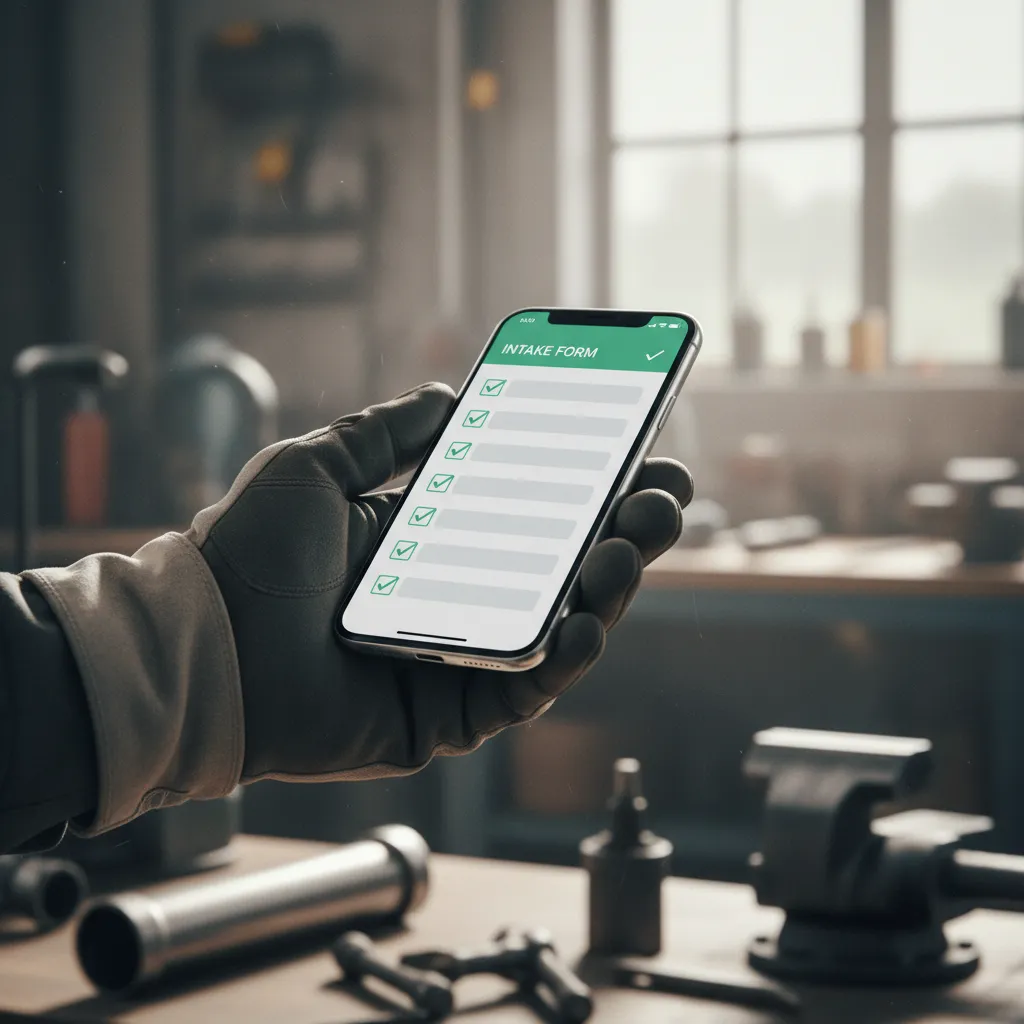
Use Job-Type Segmentation in Lead Forms
Force the prospect to choose:
- ✅ Emergency repair (same-day dispatch)
- ✅ Drain clearing / water heater replacement
- ✅ Whole-home repipe or sewer line replacement
- ✅ Routine maintenance / inspection
Each selection triggers different follow-up messaging, different techs, and different capacity allocation. You're not asking for information. You're forcing intent declaration.
Display Pricing Guardrails, Not Estimates
Include language like: 'Diagnostic visits start at $129, credited toward approved work. Most water heater replacements range $1,800–$3,200 depending on unit type and code requirements.'
This doesn't scare away serious buyers. It evaporates the $99 crowd before they enter your pipeline.
"⭐️ Dolead Expert Tip: We've seen conversion rates increase 18–24% when operators add job-type selectors and pricing context to intake forms. The volume drops 12–15%, but ticket average climbs 30%+. You're not losing leads. You're losing waste."
Challenge: Trust Signals Are Buried or Generic
Homeowners choosing a plumber face asymmetric risk. A bad hire can mean water damage, code violations, or a $6,000 re-do. Your competitors all claim to be licensed, insured, and experienced. None of that differentiates.
If your messaging relies on 'trusted since 1987' or '500+ five-star reviews,' you're speaking the same language as every other operator in your service radius.
Solution: Deploy Specific, Auditable Proof Points
License Numbers and Certifications (Visible, Not Buried)
Don't just say 'licensed and insured.' Display: 'Master Plumber License #12345 (State Board Verified). $2M General Liability. Workers Comp Certificate Available on Request.'
This isn't about legality. It's about forcing competitors to match specificity. Most can't.
Project Portfolios With Measurable Outcomes
Replace testimonials with case summaries:
- 💡 'Replaced cast iron stack in 1940s bungalow — 0 drywall demo, epoxy lining system, 3-day turnaround.'
- 💡 'Tankless conversion (gas to electric) — included panel upgrade, $1,200 utility rebate secured for homeowner.'
You're not asking them to trust you. You're giving them pattern recognition for their exact scenario.
Guarantee Structure (Not Just 'Satisfaction Guaranteed')
Be surgical:
- 🔒 'All drain clearing work guaranteed clog-free for 90 days or we return at no charge.'
- 🔒 'Water heater installations include 5-year labor warranty and manufacturer's parts coverage transfer.'
Vague guarantees are noise. Specific guarantees are risk-transfer mechanisms that close deals.
"📌 Partner Note: Compliance is built into our validation rules so you don't buy risk."
Challenge: Speed-to-Contact Becomes a Race to the Bottom
You've been told that the first company to call wins. So you've optimized for response time instead of response quality. Your CSRs are trained to connect fast, not to diagnose fit.
The result: you're in a bidding war with competitors who called 90 seconds faster, and the homeowner is now comparing three nearly identical quotes for a job that doesn't match your ideal ticket profile.
Solution: Pre-Frame Expectations During the Wait
Immediate Confirmation With Next-Step Clarity
The second a lead submits, they should receive:
- ✅ Confirmation that inquiry was received
- ✅ What happens next (e.g., 'A licensed plumber will call within 2 hours to schedule your diagnostic visit')
- ✅ What to prepare (e.g., 'Please have access to your water heater and main shutoff location ready')
You're not stalling. You're establishing process credibility while competitors are leaving voicemails.
Educational Microsites or SMS Sequences
Between form submission and first contact, send:
- 📚 A 60-second video: 'What to expect during your plumbing diagnostic visit'
- 📚 A checklist: 'How to identify if your issue requires emergency dispatch vs. scheduled service'
- 📚 Pricing context: 'Why plumbing estimates vary — and what flat-rate pricing actually covers'
By the time your CSR calls, the homeowner has been pre-sold on your process, not just your speed.
Dispatch Confirmation (Not Just Appointment Confirmation)
When you book the job, send:
- 👤 Tech name and photo
- 👤 License number and years of experience
- 👤 Arrival window (not 'between 8 and 5')
- 👤 What they'll assess and what diagnostic tools they carry
This isn't customer service theater. It's friction reduction. The homeowner isn't wondering if you're legitimate. They're preparing the workspace.
Challenge: Your CRM Treats All Leads the Same
A homeowner requesting a whole-home repipe estimate gets the same intake script as someone with a leaking toilet flapper. Your CSRs have no playbook for segmenting by job value, urgency, or capacity fit.
The result: high-value projects get under-nurtured while your team burns hours on $200 service calls that could've been filtered at intake.
Solution: Build Lead Scoring and Routing Architecture
Assign Point Values Based on Job Type and Situational Flags
Create a scoring model:
- 🚀 Emergency dispatch request = +20 points (high urgency, premium pricing tolerance)
- 🚀 Sewer line replacement / whole-home repipe = +30 points (high ticket, long sales cycle)
- 🚀 Water heater replacement = +15 points (mid-ticket, fast close)
- 🚀 Drain clearing / minor repair = +5 points (low ticket, volume play)
Leads scoring 25+ go to your senior CSR or owner. Leads under 10 get automated scheduling or apprentice dispatch.
Route Based on Capacity, Not Just Speed
If your crews are at 90% utilization, stop prioritizing same-day emergency requests unless they're true emergencies (flooding, gas leak). Route lower-urgency, higher-ticket projects to your best closers.
You're not ignoring leads. You're allocating labor to margin, not just speed.
Use CRM Tags to Track Lead Source Messaging
Tag every lead with:
- 🏷️ Which ad set they came from (emergency vs. planned project)
- 🏷️ What pricing context they saw (if any)
- 🏷️ Whether they selected a job type or submitted a generic inquiry
This lets you reverse-engineer which messaging environments produce the best ticket averages, not just the highest volume.
"⭐️ Dolead Expert Tip: Operators who implement lead scoring see 32% higher close rates on jobs over $2,000 because their best closers aren't wasting cycles on $150 service calls. You're not working harder. You're working selective."
Challenge: Your Messaging Doesn't Differentiate by Customer Sophistication
A homeowner Googling 'emergency plumber near me' at 11 PM has different intent and price sensitivity than someone researching 'PEX vs. copper repiping costs' at 2 PM on a Tuesday.
Most plumbing marketing treats these identically. Same landing page. Same intake form. Same follow-up cadence. The result: you're under-serving high-intent planners and over-promising to panic buyers.
Solution: Segment Messaging by Search Intent and Timing
Emergency Traffic: Minimize Decision Fatigue
For after-hours or emergency-flagged searches:
- 🚨 Single CTA: 'Call Now for Same-Day Dispatch'
- 🚨 No multi-step forms: Name, phone, address, issue type. That's it.
- 🚨 Immediate human contact: Auto-dial from form submission or live chat with dispatch authority
You're not educating. You're removing obstacles to connection.
Planned Project Traffic: Maximize Pre-Qualification
For informational searches (cost guides, how-to content, comparison articles):
- 📋 Longer intake forms: Include budget range, project timeline, property age, existing system type
- 📋 Educational nurture sequences: 3–5 emails over 10 days with case studies, financing options, and rebate eligibility
- 📋 Scheduled consultation vs. immediate dispatch: Offer calendar booking for in-home assessments, not same-day urgency
You're not creating friction. You're filtering for serious buyers and giving them a decision framework.
Seasonal Messaging Adjustments
In winter: emphasize frozen pipe prevention, water heater failures, and emergency availability.
In spring/summer: emphasize repiping, sewer line replacements, and whole-home plumbing inspections for home sellers.
Your capacity allocation should match seasonal intent, not just seasonal volume.
Challenge: You're Buying Leads, Not Building Lead Systems
Most plumbing companies treat lead generation as a procurement problem. They buy from aggregators, pay per click, or run ads without feedback loops. When leads don't convert, they blame the source, not the system.
The result: no institutional knowledge about what messaging works, what job types convert, or which lead sources produce profitable work.
Solution: Build Closed-Loop Attribution and Feedback Systems
Track Every Lead From Intake to Invoice
Your CRM should connect:
- ⚙️ Lead source (ad campaign, referral, organic search)
- ⚙️ Intake details (job type, urgency, budget)
- ⚙️ Disposition (booked, quoted, lost to competitor, not qualified)
- ⚙️ Job outcome (completed ticket value, margin, payment terms)
Without this, you're optimizing for volume, not profit.
Run Monthly Lead Source Reviews
Every 30 days, analyze:
- 📊 Cost per lead by source
- 📊 Close rate by source
- 📊 Average ticket value by source
- 📊 Profit per lead (not just revenue)
If a lead source delivers $35 CPL with a 40% close rate and $1,800 average ticket, it's better than a $20 CPL source with 15% close rate and $600 ticket. This isn't obvious until you track it.
Feed Conversion Data Back Into Targeting
If water heater replacement leads close at 55% but drain clearing closes at 18%, shift ad spend toward water heater campaigns. If leads from ZIP codes with homes built before 1980 have 2.3x higher ticket averages, adjust geo-targeting.
You're not guessing. You're engineering lead composition.
"📌 Partner Note: We keep the process auditable and safe."
Challenge: Your Techs Aren't Trained to Handle Pre-Framed Leads
You've done the work to architect better messaging, install qualification filters, and route leads intelligently. Then your tech shows up and re-explains everything the homeowner already agreed to.
This isn't a sales problem. It's a continuity problem. Your tech doesn't know what messaging the homeowner saw, what expectations were set, or what pricing context they accepted.
Solution: Equip Techs With Lead Context, Not Just Addresses
Dispatch Notes Should Include Messaging Touchpoints
When a tech gets dispatched, they should see:
- 📝 What ad or landing page the lead came from
- 📝 What job type the homeowner selected
- 📝 What pricing context was displayed
- 📝 Any educational content they received (video, email, SMS)
This lets the tech continue the conversation, not restart it.
Create Pre-Call Briefing Protocols
Before the tech leaves for the job, a 60-second review:
'Homeowner requested whole-home repipe estimate. They saw pricing range of $8K–$15K depending on square footage and access. They watched the PEX vs. copper video. Expect questions about warranty and rebate eligibility.'
You're not micromanaging. You're eliminating redundant discovery.
Use Mobile CRM for Real-Time Updates
If the homeowner texts with new information or changes urgency level, the tech sees it before arrival. If the CSR learned the homeowner is comparing three quotes, the tech knows to lead with differentiation, not just diagnosis.
This is operational continuity, not sales training.
Challenge: You're Not Measuring Messaging Performance, Just Lead Performance
Your dashboard shows cost per lead, close rate, and revenue per lead. It doesn't show:
- ❓ Which ad headlines produced the highest ticket averages
- ❓ Which landing page variations had the best qualified-to-close ratios
- ❓ Which intake form fields correlated with faster sales cycles
Without this, you're optimizing the wrong variables.
Solution: Instrument Your Funnel for Messaging Attribution
A/B Test Pre-Qualification Elements
Run parallel campaigns:
- 🧪 Version A: Generic 'plumbing services' ad → Open-ended contact form → Standard follow-up
- 🧪 Version B: Specific 'water heater replacement' ad → Job-type selector form → Pricing-contextualized follow-up
Measure:
- 📈 Form completion rate (lower is often better if you're filtering)
- 📈 Time-to-close
- 📈 Ticket average
- 📈 Profit per inquiry (the only metric that matters)
In most cases, Version B will have 20–30% lower inquiry volume but 40–60% higher profitability per inquiry.
Track Which Trust Signals Drive Action
Test:
- 🔍 License number visibility vs. generic 'licensed and insured'
- 🔍 Specific guarantees vs. vague satisfaction promises
- 🔍 Tech bios with photos vs. anonymous dispatch
Use heatmaps and scroll tracking to see which elements get attention. Use post-close surveys to ask: 'What made you choose us over competitors?'
You're not guessing what builds trust. You're measuring it.
Measure Lead Quality Decay Over Time
If a lead isn't contacted within 4 hours, what happens to close rate? If a lead doesn't book within 48 hours of first contact, what's the probability they ever close?
This tells you where to allocate follow-up effort. If close rate drops 60% after 24 hours, your follow-up sequence after day 1 is wasted labor.
"⭐️ Dolead Expert Tip: Operators who instrument messaging attribution discover that 12–18% of their lead spend is generating inquiries that never had a realistic chance of closing. Cutting that spend and reallocating it to high-intent campaigns often increases profit by 25%+ with zero volume increase."
Challenge: You're Competing on Speed Instead of Certainty
Every competitor in your market is optimizing for the same thing: first to call. So you've invested in auto-dialers, instant SMS confirmations, and 24/7 CSR coverage.
But homeowners don't just want speed. They want certainty. Certainty that you'll show up. Certainty about cost. Certainty that you won't upsell them into a $4,000 job they didn't need.
Speed without certainty is just noise.
Solution: Architect Certainty Into Every Touchpoint
Guaranteed Arrival Windows (Not Ranges)
Don't say 'we'll be there between 1 and 5.' Say: 'Your tech will arrive at 2:40 PM. You'll receive a text with GPS tracking 30 minutes before arrival.'
If you can't hit that precision, don't promise it. But if you can, it's a massive differentiation lever.
Upfront Diagnostic Pricing
Charge for diagnostics. Make it clear. Credit it toward approved work. This does three things:
- ✔️ Filters out price shoppers who want free quotes from six companies
- ✔️ Compensates your tech for expertise, not just wrench time
- ✔️ Signals that you're not a commodity service
Homeowners who pay $129 for a diagnostic are 3–4x more likely to approve the work than those who got a 'free estimate.'
Post-Job Documentation
After every job, send:
- 📄 Itemized invoice with labor and materials breakdown
- 📄 Photos of work performed (before/after)
- 📄 Warranty details and claim process
- 📄 Maintenance recommendations with timeline
This isn't about upselling. It's about creating a reference artifact the homeowner can show their spouse, their insurance company, or the next buyer of their home.
Certainty compounds into referrals.
10-Point Operational Audit: Plumbing Lead System Performance
Use this diagnostic to identify where your lead system is bleeding profit. Each point should be scored Pass / Fail. If you have more than 3 failures, your messaging architecture needs immediate intervention.
- 1️⃣ Job-Type Segmentation: Does your intake form force prospects to declare job type (emergency, replacement, repipe, maintenance) before submission?
- 2️⃣ Pricing Context Visibility: Do prospects see diagnostic fees, service call minimums, or project cost ranges before they submit?
- 3️⃣ Lead Scoring in CRM: Are leads assigned point values based on job type, urgency, and estimated ticket size?
- 4️⃣ Routing Logic: Are high-value leads (25+ points) routed to senior closers instead of generic dispatch?
- 5️⃣ Messaging Attribution Tags: Does every lead carry metadata showing which ad, landing page, and messaging they saw?
- 6️⃣ Tech Briefing Protocol: Do techs receive pre-call briefs that include what the homeowner was told during intake?
- 7️⃣ Post-Submit Nurture: Do leads receive educational content (video, checklist, or SMS) between form submission and first contact?
- 8️⃣ Closed-Loop Tracking: Can you calculate profit per lead by source, not just cost per lead or close rate?
- 9️⃣ A/B Testing Infrastructure: Are you running parallel campaigns to test messaging elements (job-specific vs. generic, pricing visibility vs. none)?
- 🔟 Lead Quality Decay Analysis: Do you measure how close rate changes based on time-to-contact and time-to-booking?
If you passed fewer than 7 of these, you're optimizing for lead volume instead of lead yield. That's fixable, but it requires architectural changes, not just more ad spend.
Lead Economics: Yield Per Lead vs. Cost Per Lead
Most plumbing operators measure success by cost per lead (CPL). But CPL is a vanity metric if you don't know what each lead is worth after it closes.
The real metric is Yield Per Lead (YPL) — the average profit generated per inquiry, accounting for close rate, ticket average, and margin.
The Math Behind Yield Per Lead
Here's the formula:
YPL = (Close Rate × Average Ticket × Margin) − Cost Per Lead
Let's compare two lead sources:
Source A (Low CPL, High Volume):
- 💵 Cost per lead: $20
- 💵 Close rate: 18%
- 💵 Average ticket: $650
- 💵 Margin: 40%
Calculation: (0.18 × $650 × 0.40) − $20 = $26.80 YPL
Source B (Higher CPL, Lower Volume, Better Qualification):
- 💵 Cost per lead: $42
- 💵 Close rate: 47%
- 💵 Average ticket: $1,850
- 💵 Margin: 42%
Calculation: (0.47 × $1,850 × 0.42) − $42 = $322.39 YPL
Source B delivers 12x more profit per inquiry, even though it costs 2.1x more per lead. If you're optimizing for CPL, you'd kill Source B and scale Source A. If you're optimizing for profit, you'd do the opposite.
Why Most Operators Get This Wrong
Your dashboard shows cost per lead because that's what your ad platform reports. It doesn't show yield per lead because that requires connecting marketing data to CRM disposition data to invoicing data.
Most plumbing companies don't have that integration. So they optimize for the metric they can see (CPL) and ignore the metric that determines profitability (YPL).
The fix: build closed-loop attribution. Track every lead from source to invoice. Calculate YPL monthly by source. Kill or de-prioritize sources with YPL below your threshold, even if their CPL looks attractive.
When Low CPL Is a Red Flag
If your CPL drops suddenly, it's often because:
- ⚠️ Your targeting broadened (now attracting unqualified traffic)
- ⚠️ Your messaging became more generic (higher form completion, lower intent)
- ⚠️ A competitor stopped bidding (you're now attracting bottom-tier searchers)
Low CPL isn't inherently good. It's only good if YPL stays constant or improves. If YPL drops, your 'cheaper' leads are actually more expensive per dollar of profit.
Standard Operating Procedures: Lead Follow-Up & CRM Integration
Most plumbing companies treat lead follow-up as a CSR function. It's not. It's a systems function. Here's how to operationalize it.
SOP 1: Lead Intake and Immediate Acknowledgment
Trigger: Lead submits form or calls main line.
Action Sequence:
- 1️⃣ Instant auto-reply (email or SMS): Confirm receipt. State next step ('A licensed plumber will call within 2 hours'). Include pricing context or FAQ link.
- 2️⃣ CRM entry: Lead auto-populates with source tag, job type, timestamp, and priority score.
- 3️⃣ Routing: If priority score ≥ 25, assign to senior CSR. If < 25, assign to standard rotation.
- 4️⃣ Educational content delivery: Send 60-second explainer video or service overview PDF via SMS or email.
Failure Mode: Lead waits 4+ hours with no acknowledgment. They've already contacted two competitors and formed expectations you now have to override.
SOP 2: First Contact and Qualification
Trigger: CSR initiates first call (target: within 2 hours of submission).
Action Sequence:
- 1️⃣ Verify lead context: Review CRM notes showing what ad they saw, what job type they selected, what pricing they were shown.
- 2️⃣ Confirm job details: 'I see you requested a water heater replacement estimate. Can you tell me about the current unit — is it gas or electric, and are you experiencing a failure or planning an upgrade?'
- 3️⃣ Set diagnostic pricing expectation: 'Our diagnostic visit is $129, and that's credited toward any approved work. Most water heater replacements run $1,800–$3,200 depending on unit type and installation complexity. Does that align with what you're prepared to invest?'
- 4️⃣ Book or disqualify: If budget/timeline aligns, book diagnostic. If not, offer maintenance plan or future follow-up. Don't chase low-probability conversions.
Failure Mode: CSR asks open-ended questions without referencing what the homeowner already submitted. The homeowner repeats themselves and loses confidence in your process.
SOP 3: Pre-Dispatch Tech Briefing
Trigger: Job is booked and assigned to a tech.
Action Sequence:
- 1️⃣ Tech receives dispatch note with: Homeowner name, address, job type, pricing context they saw, any educational content they received, and CSR notes from qualification call.
- 2️⃣ Pre-departure review (60 seconds): Tech reads notes and identifies likely objections or questions (e.g., 'Homeowner is comparing tankless vs. traditional — be ready to explain lifecycle cost').
- 3️⃣ Arrival confirmation: Tech sends SMS 30 minutes before arrival with name, photo, and ETA.
Failure Mode: Tech arrives with no context and has to re-ask everything the CSR already covered. Homeowner perceives disorganization and comparison-shops harder.
SOP 4: Post-Job Documentation and Follow-Up
Trigger: Job is completed and invoiced.
Action Sequence:
- 1️⃣ Immediate invoice delivery: Email itemized invoice with labor/materials breakdown, before/after photos, and warranty details.
- 2️⃣ 72-hour follow-up: Automated SMS or email: 'How's the new water heater performing? Any questions about operation or warranty?'
- 3️⃣ 30-day maintenance reminder: 'It's been a month since your water heater installation. Here's a quick checklist to ensure optimal performance.'
- 4️⃣ Annual service offer: One year later, offer maintenance inspection at discounted rate.
Failure Mode: Homeowner receives invoice and nothing else. No follow-up. No relationship continuity. When they need service again, they start from scratch with Google.
Why a Lead Generation Partner is the Right Solution for You
Dolead operates as an operational extension of your business, absorbing the marketing risk by delivering validated, exclusive leads on a strict pay-per-lead model.
About the Author
Guillaume Heintz is an operator-grade lead generation expert with decades of experience helping plumbing professionals scale using performance-based marketing strategies.


.svg)
.svg)
.svg)
.svg)


