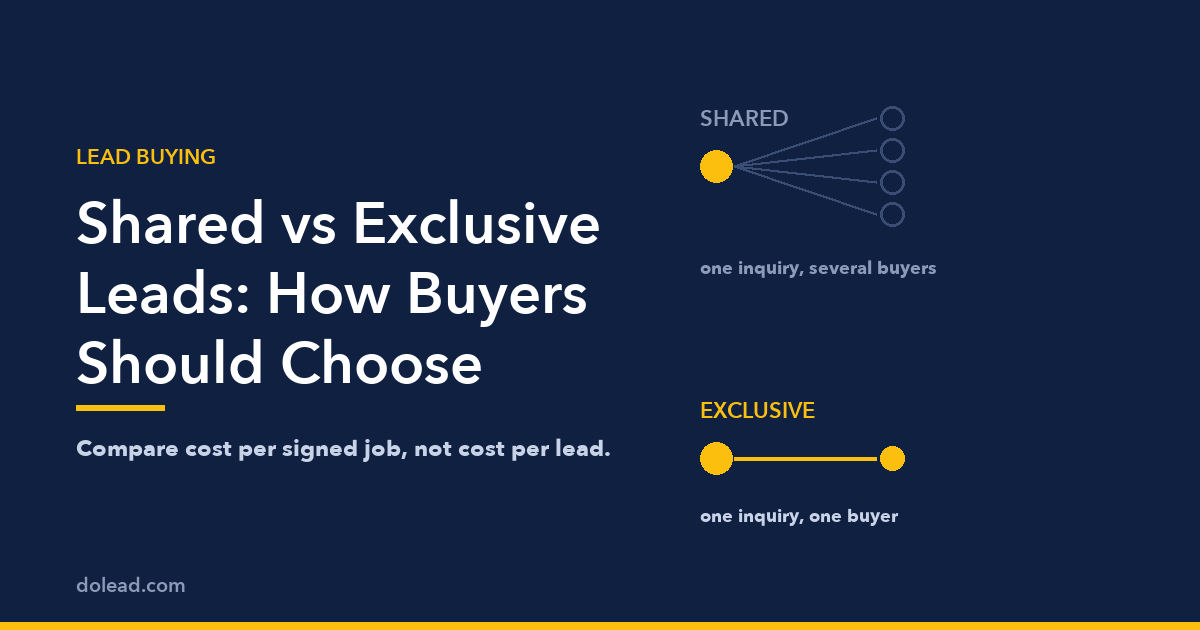
Shared leads sell one inquiry to several buyers, so each costs less and the winner is usually whoever calls first. Exclusive leads go to a single buyer, so each costs more and meets no rivals. Neither wins outright. Compare cost per signed job, not cost per lead, and match the model to your response speed.
What is the difference between shared and exclusive leads?
A lead is a request from a person who wants an estimate, a booking or a call, captured through a form, a call or a chat. The seller then decides how many buyers receive it.
- Shared lead: the same inquiry is delivered to more than one buyer. The number varies by seller, and some sell it to a handful of competitors at once. The consumer may hear from several companies within minutes.
- Exclusive lead: the inquiry is delivered to one buyer only. You are the only company the consumer should hear from through that channel.
- Semi-exclusive or limited-share lead: the inquiry goes to a small, capped number of buyers. The label sits between the two, so it needs a written definition from the seller.
The label on its own tells you little. Sellers define "exclusive" in different ways: one buyer for the life of the lead, one buyer per trade within a territory, or one buyer for a window of days before the inquiry is resold.
The pricing logic follows from the model. A shared lead can be sold several times, so the seller can charge each buyer less. An exclusive lead can be sold once, so the price has to cover the full cost of acquiring the consumer. That is the whole reason for the price gap, and it also tells you what to measure.
How much do shared and exclusive leads cost?
There is no public price list that covers both models. Marketplaces set prices by trade, job size, location and demand, and most do not publish a rate card. Any single "average price per lead" you see quoted for shared or exclusive leads is usually a vendor claim, so treat it as a starting point for negotiation rather than as a benchmark.
What you can anchor on is the price of generating the same inquiry yourself. The table below uses published 2026 search advertising averages, which show what a lead costs when you buy the clicks and run the landing page yourself. Home services businesses such as roofing, HVAC and plumbing likely sit closest to the Home and Home Improvement row.
These are averages over many advertisers, so your own account may sit well above or below them. Use them as a ceiling for reasoning, not as a price target. A purchased lead priced far above the do-it-yourself figure for your category needs a strong reason, such as exclusivity, verification or delivery speed. A purchased lead priced far below it is almost certainly shared, and you should expect to compete for it.
The comparison also shows what a lead price does not include. An advertising cost per lead of about $90.92 in the Home and Home Improvement category measures a form fill or a call, not a booked appointment and not a signed job. Every lead model, shared or exclusive, only becomes comparable once you carry the number all the way down to the job. For a deeper look at why the front-end number misleads, see why cost per lead is an incomplete measure of quality.
What does each model really cost per signed job?
Cost per signed job is the price you pay per lead divided by the share of those leads that become signed work. Both inputs matter, and they move in opposite directions between the two models.
A shared lead is cheaper per lead but typically closes at a lower rate, because the consumer is talking to several companies. An exclusive lead costs more per lead but typically closes at a higher rate, because you are the only caller. Whether the extra price pays for itself depends on how much better the close rate is.
The break-even rule is simple and needs no benchmark. If an exclusive lead costs twice as much as a shared lead, it has to close at more than twice the rate to cost less per signed job. If it costs three times as much, it has to close at more than three times the rate. Below that line the shared lead is the cheaper way to buy work, and above it the exclusive lead is.
No independent public dataset compares close rates for shared and exclusive leads in any trade. Numbers published by sellers differ widely and are rarely measured the same way. Do not borrow someone else's close rate to make this decision. Measure your own, and measure it on signed jobs rather than on appointments set.
Four inputs change the answer for your business:
- Job value: the higher the margin on one signed job, the more a premium per lead is worth. A single replacement roof or heating system can justify a higher lead price than a small repair can.
- Sales cycle: long, considered purchases reward being the only company the consumer hears from. Urgent, one-call purchases reward whoever answers first.
- Capacity to call fast: shared leads punish slow follow-up and exclusive leads forgive it more.
- Volume you can handle: shared leads let you scale volume at a lower price per lead, as long as you have the people to work them.
When do shared leads make sense?
Shared leads make sense when you can reach the consumer before your competitors do, and when your margin per job leaves room for a lower close rate.
Speed is the deciding factor. In a Harvard Business Review study of 1.25 million sales leads from 42 companies, firms that tried to contact a lead within an hour were nearly seven times as likely to qualify it as firms that waited an hour longer, and more than 60 times as likely as firms that waited 24 hours or more. The study did not test shared against exclusive leads, but its logic carries over directly. When several companies receive the same inquiry, the first company to hold a real conversation has a large head start.
Most companies are slower than they think. In the same research, 37% of 2,241 audited firms replied to a web inquiry within an hour, 23% never replied, and the average reply among firms that answered within 30 days took 42 hours. A business that answers every inquiry in minutes starts from a strong position, because it competes against that field. This is the real case for shared leads: they reward operational speed, and operational speed is something you control.
Shared leads fit best in these situations:
- You have a dispatcher, call handler or inside sales rep who can reach each lead within minutes during business hours.
- Your jobs are small or repeatable, so a lower close rate still leaves a healthy margin.
- You want volume to fill a schedule, a new territory or a quiet season, and you can pay less per lead to get it.
- You are testing a new trade, zip code or service line and want to learn before committing budget to a higher-priced model.
The weak points are equally clear. If your team follows up the next day, a shared lead has often already been sold on. If you cannot see how many other buyers received the inquiry, you cannot judge how much of the price gap is real. For a worked routing example, read the speed-to-lead routing guide for plumbing companies, which applies to any urgent trade.
When do exclusive leads make sense?
Exclusive leads make sense when each job is worth enough to carry a higher lead price, when your team cannot always respond within minutes, or when the consumer's decision takes several conversations.
Two situations favor exclusivity:
- High-ticket, considered purchases. Roof replacements, whole-home HVAC systems, solar installations and large remodels involve research, estimates and a decision that can take days or weeks. Being the only company the consumer is talking to means you can follow up without a bidding war. You can see how this plays out in the vertical pages for roofing lead generation and HVAC lead generation.
- Small or part-time sales teams. If the owner is on a roof half the day, a shared lead is often lost before anyone calls. An exclusive lead gives you a longer window to respond, though speed still improves the result.
Exclusivity has limits:
- It is not a guarantee of a signed job. The consumer can still ignore you, choose a company they found another way, or cancel the project.
- The definition can be narrow. An inquiry sold to one buyer today may be resold after a set number of days. Ask whether the exclusivity is permanent.
- It costs more when you are wrong. A shared lead that does not convert is a cheap mistake. An exclusive lead that does not convert costs you the whole premium.
Do consent and compliance rules differ between shared and exclusive leads?
They can, and this is the least understood part of the decision. If you call or text a lead using automated dialing or pre-recorded voice, consent rules under US telemarketing law apply, and the way a lead was collected matters.
In late 2023 the FCC adopted a rule to close what it called the "lead generator loophole," under which one consent form could cover calls from many companies. The rule would have required consent to be given one seller at a time. On January 24, 2025, the Eleventh Circuit vacated that rule in Insurance Marketing Coalition v. FCC, finding that it exceeded the agency's statutory authority under the Telephone Consumer Protection Act.
What that means in practice:
- The ruling itself means the federal one-to-one requirement never took effect, so a shared lead is not unlawful merely because several companies receive it. That describes the ruling, not the current state of play: the FCC has acted further since, and consent and revocation requirements have continued to change through 2025 and 2026.
- Consent still has to be real, specific and documented. A form that names your company, or clearly describes the category of sellers who may contact the consumer, is stronger than a vague disclosure.
- Several US states maintain their own, stricter requirements, so a federal position is not the whole picture if you operate across state lines.
- With an exclusive lead, the question of who the consumer agreed to hear from is simpler, because a single company is named.
This is not legal advice. Read the FCC's own current orders and confirm your calling and texting practices with a lawyer who handles telemarketing law before you rely on anything here. The commercial point is narrower: whichever model you buy, ask the seller to show the consent language and the timestamp for a sample of leads before you scale spend.
What should you ask a lead seller before you buy?
Ask the same questions of every seller, shared or exclusive, and write the answers down. A seller who cannot answer clearly has told you something useful.
- How many buyers receive each lead? Get a number or a cap, not "a few".
- How is "exclusive" defined? Ask whether it covers one buyer per trade, per territory or per time window, and whether the inquiry is ever resold.
- Where does the lead come from? Paid search, social, a marketplace, a comparison site or a call. Source affects intent and close rate.
- How fast is it delivered? Ask for the average delay between the consumer submitting the form and the lead reaching you, and whether delivery is by phone transfer, webhook, email or app alert.
- What is the return or credit policy? Duplicates, wrong numbers, outside-area requests and out-of-scope jobs should be refundable, with a defined window and proof standard.
- What consent evidence can you see? The form wording, timestamp, consumer IP and the list of sellers named, for any lead you pay for.
- Can you trace results back to the lead? You need a lead identifier on every record so you can match jobs and revenue to the source later.
How do you test shared leads against exclusive leads?
Run a controlled test for long enough to see signed jobs, not only appointments. The aim is a cost per signed job for each model, using your own sales process.
- Define the comparison. Pick one trade, one territory and one job type, so the two models face the same demand.
- Match the volume. Buy the same number of leads from each model, or as close as budgets allow. A small sample produces a misleading close rate in either direction.
- Hold your process constant. Use the same people, the same script, the same follow-up sequence and the same response-time target for both. If you answer exclusive leads faster, you are measuring your speed, not the lead.
- Record every step. For each lead record the time to first contact, whether you reached the consumer, whether an appointment was booked, whether an estimate was sent and whether a job was signed.
- Run it for a full sales cycle. For urgent trades that may be a few weeks. For roofing, solar or large remodels it can be a couple of months.
- Compute cost per signed job and payback. Divide total spend by signed jobs for each model, then compare the result with the gross margin on a typical job.
- Decide by segment, not by headline. The answer is often a mix: exclusive leads for high-value job types and territories where you cannot afford to lose the consumer, shared leads for volume and for small jobs.
Review the split every quarter, because lead quality, competition and your own response speed all change.
What else do buyers ask about shared and exclusive leads?
Are exclusive leads always better than shared leads?
No. Exclusive leads remove competition for the same inquiry, which usually helps the close rate, but they cost more per lead and do not guarantee a signed job. Shared leads can produce a lower cost per signed job when you respond fast and your jobs are small or frequent. The only reliable answer is your own cost per signed job from a controlled test.
What is a good cost per lead for a home services business?
It depends on the trade, the market and the quality of the lead. As a reference point, published 2026 search advertising averages put the Home and Home Improvement category at $90.92 per lead, against $66.69 for all industries. Treat these as context for what generating a lead yourself costs.
How quickly should you call a shared lead?
As fast as you can, ideally within minutes. In the Harvard Business Review research, firms that contacted a lead within an hour were nearly seven times as likely to qualify it as firms that waited another hour. With a shared lead, other buyers are making the same call, so delay costs more.
What is a semi-exclusive lead?
A semi-exclusive lead is sold to a small, capped number of buyers rather than to one. The cap and the rules vary by seller, and some count a lead as exclusive per trade or per time window. Ask for the number of buyers and the definition in writing, then test it as if it were a shared lead.
Can you mix shared and exclusive leads?
Yes, and many buyers do. A common pattern is to buy exclusive leads for high-value job types and territories, and shared leads for volume and for smaller jobs. Track cost per signed job separately for each source so you can shift budget as the numbers change. If you want to see how performance-based pricing is structured for a given trade, the roofing lead generation page is a good starting point.