Most plumbing shops treat lead generation and sales as separate problems. You run ads, answer phones, and then watch your techs burn hours educating price shoppers who were never ready to book. The real issue isn't lead volume—it's that your plumbing lead generation solutions didn't establish the right expectations before the lead entered your system. By the time your CSR picks up the phone, you're already playing defense.
Pre-framing is the discipline of setting expectations, establishing positioning, and filtering intent before the lead reaches your CRM. When done correctly, it eliminates 60-70% of common objections, shortens your sales cycle by days, and protects your crew capacity from tire-kickers who should never have been routed to dispatch.
This guide breaks down the operational mechanics of pre-framing in plumbing marketing: what to communicate, where to place it, and how to measure whether it's actually reducing friction in your sales process.
Challenge: Leads Arrive With Zero Context About Your Pricing Model
Your tech shows up expecting a simple drain snake. The homeowner was quoted $79 by a competitor and assumes that's the going rate. Your flat-rate book says $240 for the same job because you're pricing for long-term value, not bottom-feeder competition.
The disconnect isn't a sales problem—it's a messaging gap. The lead was never told what kind of operation you run, what your pricing philosophy is, or why they should expect professional-grade service at professional-grade rates.
When you skip pre-framing, every job becomes a negotiation. Your close rate drops. Your techs feel like they're constantly defending price. And your average ticket stays suppressed because customers anchor to the lowest number they saw online.
Solution: Build Pricing Philosophy Into Your Lead Capture Flow
Pre-framing starts at first contact. Whether the lead comes from paid search, a landing page, or a phone call, you need to establish what kind of plumbing company you are before they ever ask for a quote.
Here's the structure:
1️⃣ Positioning Statement (First 10 Seconds)
Don't lead with 'licensed and insured'—everyone says that. Lead with your operational model: same-day service, flat-rate pricing, background-checked techs, and guaranteed work. This isn't marketing fluff; it's a filter. Price shoppers will self-select out. Quality-focused homeowners will lean in.
Example landing page headline: 'Same-Day Plumbing Repairs With Transparent, Flat-Rate Pricing—No Surprises, No Hourly Games.'
That single line pre-frames three things: speed, pricing model, and trust. Anyone looking for the cheapest hourly rate will bounce. That's a feature, not a bug.
2️⃣ Service Delivery Expectations (Lead Form or Call Script)
Before you ask for their contact info, tell them what happens next. Most plumbing sites bury this or skip it entirely. That's a mistake. Leads want to know the process before they commit.
Add this to your form confirmation page or have your CSR say it verbatim:
"Here's what happens next: We'll confirm your service window within 15 minutes. Your tech will text you their photo and ETA. You'll receive flat-rate pricing options before any work starts. If you approve, we finish the job same-day. If not, you pay nothing for the visit."
You've just eliminated the two biggest objections—uncertainty about cost and fear of being locked into a bill they didn't approve.
3️⃣ Testimonial Placement (Social Proof on Pricing)
Most plumbing sites use generic testimonials: 'Great service, very professional.' That doesn't address the real objection—price anxiety. Instead, curate reviews that specifically mention transparent pricing, no upsells, or fair rates for quality work.
Example: 'I thought $350 was high for a toilet repair until the tech showed me exactly what was broken and why it needed a full rebuild. They gave me three options, no pressure. Worth every dollar.'
That testimonial does three things: it acknowledges price skepticism, validates your diagnostic process, and reinforces option-based selling. Leads read that and arrive expecting a consultative interaction, not a hard close.
"⭐️ Dolead Expert Tip: Pre-framing works when it's specific. Don't say 'fair pricing'—say 'flat-rate pricing with three service tiers.' Don't say 'fast service'—say 'same-day or next-day dispatch, confirmed within 15 minutes.' Vague promises create vague leads. Specificity filters intent."
Challenge: Leads Don't Understand The Difference Between A Service Call And An Estimate
This is the single biggest source of friction in residential plumbing sales. A homeowner calls asking for a 'free estimate.' Your CSR books a service call. Your tech drives 40 minutes, diagnoses the issue, and presents options. The homeowner says, 'I thought this was free.'
You've now burned dispatch time, tech time, and fuel on a lead who was never aligned with your business model. This happens because your marketing didn't explain the difference between a diagnostic visit and a project bid.
Most plumbing companies offer free estimates for large projects (repiping, water heater installs, bathroom renovations) but charge a trip fee or diagnostic fee for service calls. If your lead gen doesn't clarify that upfront, you're setting your team up for conflict.
Solution: Define Service Types In Your Intake Process
Your CSR or lead form needs to force clarity on what kind of job the customer is requesting. Here's the framework:
- 🔧 Service Call (Repair/Diagnostic): Trip fee applies (typically $79-$150). Fee is waived if they approve the repair. Tech arrives same-day or next-day. Payment due at completion.
- 📋 Project Estimate (Installation/Renovation): No charge for the estimate visit. Requires scheduled appointment (not emergency). Quote provided within 24-48 hours. Work scheduled separately after approval.
Your phone script or web form should present these as two distinct paths with clear language:
"Are you looking to repair an existing issue (leaking pipe, clogged drain, running toilet) or get a quote for a larger project like a water heater replacement or bathroom renovation?"
That single question eliminates 90% of the confusion. If they choose 'repair,' your CSR immediately follows with: 'Great—we charge a $99 diagnostic fee, which is waived if you move forward with the repair. Does that work for you?'
If they balk, they were never a qualified lead. You just saved your tech a wasted trip.
"📌 Partner Note: Compliance is built into our validation rules so you don't buy risk. Every lead spec includes service-type clarity and explicit consent on diagnostic fees."
Challenge: Leads Expect Instant Phone Quotes Without Seeing The Job
This objection is rooted in years of low-quality plumbing marketing that trained homeowners to expect pricing without context. They call and ask: 'How much to fix a leaky faucet?' Your CSR knows the answer could range from $120 to $650 depending on the fixture, accessibility, and whether parts need ordering.
If your CSR gives a range, the customer anchors to the low end. If your CSR refuses to quote, the customer assumes you're hiding something. Either way, you lose.
The solution isn't to cave and give ballpark numbers. It's to reframe the question so the lead understands why diagnostic visits exist in the first place.
Solution: Use The 'Three-Factor' Education Script
Train your CSRs to respond with this exact framework when asked for phone quotes:
"Great question. Our pricing depends on three factors: the type of fixture, accessibility, and whether we need to order parts or can complete it same-day. That's why we send a licensed tech to diagnose it first. You'll get exact pricing before any work starts, and if you choose not to move forward, you're only out the $99 trip fee. Does that make sense?"
This script does four things simultaneously:
- ✅ Validates the question: You're not dismissing their concern—you're explaining the complexity.
- ✅ Educates on variables: They now understand why phone quotes are unreliable.
- ✅ Reinforces the diagnostic model: You've positioned the trip fee as a value exchange, not a gotcha.
- ✅ Asks for confirmation: 'Does that make sense?' is a micro-close that forces engagement.
If the lead pushes back and demands a number anyway, you've identified a price-only buyer who will never convert at your rates. Let them go to the $79 competitor and call you back in six months when that repair fails.
"⭐️ Dolead Expert Tip: Track how many leads ask for phone quotes versus how many book diagnostic visits. If more than 40% of your inbound calls are quote requests, your ad copy and landing pages aren't doing enough pre-framing. The education should happen before the phone rings."
10-Point Pre-Framing Operational Audit for Plumbing Marketing
Use this checklist to evaluate whether your current lead generation system is actually filtering intent or just funneling unqualified contacts into your CRM.
1️⃣ Landing Page Positioning Statement
Audit Question: Does your landing page headline explicitly state your service model (flat-rate, same-day, diagnostic-based)?
Pass/Fail: If a homeowner could read your page and still think you're an hourly-rate handyman service, you fail. Your positioning must be unmistakable in the first 10 seconds.
2️⃣ Service Type Segmentation
Audit Question: Does your lead form or phone script force the customer to choose between 'emergency repair' and 'project estimate' before booking?
Pass/Fail: If your CSR has to ask clarifying questions after the lead submits, your intake is broken. Segmentation must happen at first contact.
3️⃣ Trip Fee Disclosure
Audit Question: Is your diagnostic fee amount and waiver policy stated explicitly on your landing page, form confirmation, and phone script?
Pass/Fail: If a customer can book a service call without knowing the trip fee exists, you're setting your tech up for conflict. Disclose upfront, always.
4️⃣ Testimonial Specificity
Audit Question: Do at least 50% of your displayed reviews mention pricing transparency, diagnostic process, or option-based selling?
Pass/Fail: Generic 'great service' reviews don't pre-frame expectations. Your social proof must address the exact objections leads have about cost and process.
5️⃣ Next-Step Clarity
Audit Question: Does your form confirmation page or post-call follow-up email explain exactly what happens after they submit (response time, tech contact, pricing presentation)?
Pass/Fail: If the lead doesn't know when to expect contact or what the tech visit will look like, you haven't pre-framed the experience. Uncertainty breeds objections.
6️⃣ Response Time Commitment
Audit Question: Do you promise a specific callback or confirmation window (e.g., 'within 15 minutes' or 'by end of business day')?
Pass/Fail: Vague promises like 'we'll get back to you soon' create anxiety. Specific commitments build trust and filter out leads who need instant answers you can't provide.
7️⃣ CRM Lead Tagging
Audit Question: Does your CRM automatically tag leads by service type (repair vs. project), source (paid vs. organic), and trip fee acknowledgment?
Pass/Fail: If your CSR has to manually interpret lead intent from a generic form submission, your automation is inadequate. Tags should be built into the intake flow.
8️⃣ CSR Script Compliance
Audit Question: Do you audit recorded calls monthly to verify CSRs are using the three-factor education script for phone quote requests?
Pass/Fail: If you're not monitoring compliance, you have no idea whether your team is reinforcing or undermining your pre-framing strategy. Spot-check at least 10 calls per month.
9️⃣ Ad Copy Alignment
Audit Question: Do your Google Ads and Facebook ads explicitly mention flat-rate pricing, same-day service, or diagnostic fees in the ad copy itself?
Pass/Fail: If your ads are generic ('licensed plumbers, call now'), you're attracting price shoppers by default. Your ad copy is the first layer of pre-framing—use it.
🔟 Conversion Rate by Source
Audit Question: Are you tracking close rate and average ticket by lead source to identify which channels deliver pre-framed, ready-to-buy leads?
Pass/Fail: If you're only measuring cost-per-lead without analyzing downstream revenue, you're optimizing for volume instead of quality. Pre-framed leads convert at 2-3x the rate of generic inquiries.
"📌 Partner Note: Our lead delivery includes source tagging, service-type validation, and fee acknowledgment flags so your CRM knows exactly what kind of lead you're getting before your CSR even picks up the phone."
The Economics of Pre-Framing: Yield Per Lead vs. Cost Per Lead
Most plumbing operators obsess over lowering their cost-per-lead (CPL). That's backwards. The metric that actually drives profitability is yield per lead—the average revenue generated from each contact, regardless of acquisition cost.
Here's the math:
Scenario A: High-Volume, Low-Quality Leads
- 💰 Cost Per Lead: $45
- 📞 Leads Per Month: 200
- 📊 Close Rate: 18%
- 💵 Average Ticket: $425
- 🎯 Booked Jobs: 36
- 🏆 Total Revenue: $15,300
- 📉 Marketing Spend: $9,000
- ✅ Yield Per Lead: $76.50
Scenario B: Pre-Framed, High-Intent Leads
- 💰 Cost Per Lead: $95
- 📞 Leads Per Month: 100
- 📊 Close Rate: 42%
- 💵 Average Ticket: $580
- 🎯 Booked Jobs: 42
- 🏆 Total Revenue: $24,360
- 📉 Marketing Spend: $9,500
- ✅ Yield Per Lead: $243.60
Scenario B costs more per lead but generates 59% more revenue with half the lead volume. Why? Because pre-framing eliminates low-intent contacts, shortens the sales cycle, and creates an environment where customers are pre-sold on your value before the tech arrives.
The hidden costs in Scenario A aren't captured in the CPL metric:
- ⚙️ CSR Time: 200 leads require 50+ hours of phone qualification vs. 25 hours for 100 pre-framed leads.
- 🚗 Wasted Dispatch: Low close rates mean more techs driving to jobs that don't convert, burning fuel and opportunity cost.
- 📉 Morale Drag: Techs who constantly face price objections become demoralized and start discounting to hit their numbers.
- 🔄 Callback Volume: Unqualified leads who don't book still call back repeatedly, tying up phone lines and CSR capacity.
When you factor in those hidden costs, Scenario A's 'cheap' leads are actually costing you $250 per booked job in total acquisition cost. Scenario B's pre-framed leads cost $226 per booked job—and they book faster, pay more, and require less sales effort.
"⭐️ Dolead Expert Tip: If your close rate is below 30%, you don't have a sales problem—you have a lead quality problem. Pre-framing should filter out at least 40% of tire-kickers before they ever hit your CRM, leaving only high-intent contacts for your team to work."
Operator SOPs: Integrating Pre-Framing Into Your Lead Follow-Up Process
Pre-framing doesn't end when the lead submits. Your follow-up process must reinforce the expectations you set during intake, or the messaging breaks down and objections resurface.
Here's the step-by-step SOP for maintaining pre-framed messaging throughout the customer journey:
SOP Step 1: Automated Confirmation Email (Sent Within 60 Seconds of Submission)
Subject Line: 'Your [Service Type] Appointment Request—Here's What Happens Next'
Body Content Must Include:
- ✅ Confirmation of service type (repair vs. project estimate)
- ✅ Trip fee amount and waiver policy (for service calls)
- ✅ Expected callback window (e.g., 'within 15 minutes during business hours')
- ✅ What the tech visit will look like (photo, ETA text, pricing presentation)
- ✅ Link to your FAQ page addressing common pricing questions
This email serves as a receipt and reinforcement. If the customer re-reads it before the tech arrives, they're reminded of the diagnostic fee and pricing process. That eliminates 'I didn't know' objections.
SOP Step 2: CSR Callback Script (Within 15 Minutes for Repairs, 2 Hours for Projects)
Opening Line: 'Hi [Name], this is [CSR] from [Company]. I see you requested a [service type]—I'm calling to confirm your appointment and walk you through what happens next.'
Required Script Elements:
- 🔧 Re-confirm service type and issue description
- 📅 Offer specific service windows (today 2-4pm, tomorrow 8-10am, etc.)
- 💰 State trip fee and waiver policy verbatim: 'There's a $99 diagnostic fee, waived if you approve the repair'
- 📲 Explain tech communication: 'Your tech will text you their photo and ETA 30 minutes before arrival'
- ❓ Ask: 'Do you have any questions about the process or pricing before we lock in your appointment?'
That final question is critical. It gives the customer one last chance to voice objections before dispatch. If they ask about pricing ranges or free estimates, your CSR uses the three-factor education script to reset expectations.
SOP Step 3: Pre-Arrival Tech Text (30 Minutes Before ETA)
Message Template: 'Hi [Name], this is [Tech Name] from [Company]. I'm your plumber for today's [service type]. Here's my photo [link]. I'll be there in about 30 minutes. Reply READY when you're available, or call me at [number] if anything changes.'
This text accomplishes three things:
- 🛡️ Security: The photo reassures the homeowner they're getting a real, uniformed tech.
- ⏰ Punctuality Signal: The 30-minute notice shows respect for their time.
- 💬 Two-Way Communication: Inviting a reply or call makes the customer feel in control.
By the time the tech knocks on the door, the customer has been pre-framed three times: intake form, CSR call, and pre-arrival text. Objections are virtually eliminated.
SOP Step 4: On-Site Diagnostic Presentation (Before Any Work Begins)
Tech Script Framework:
- 1️⃣ 'Let me show you what I found and explain your options.'
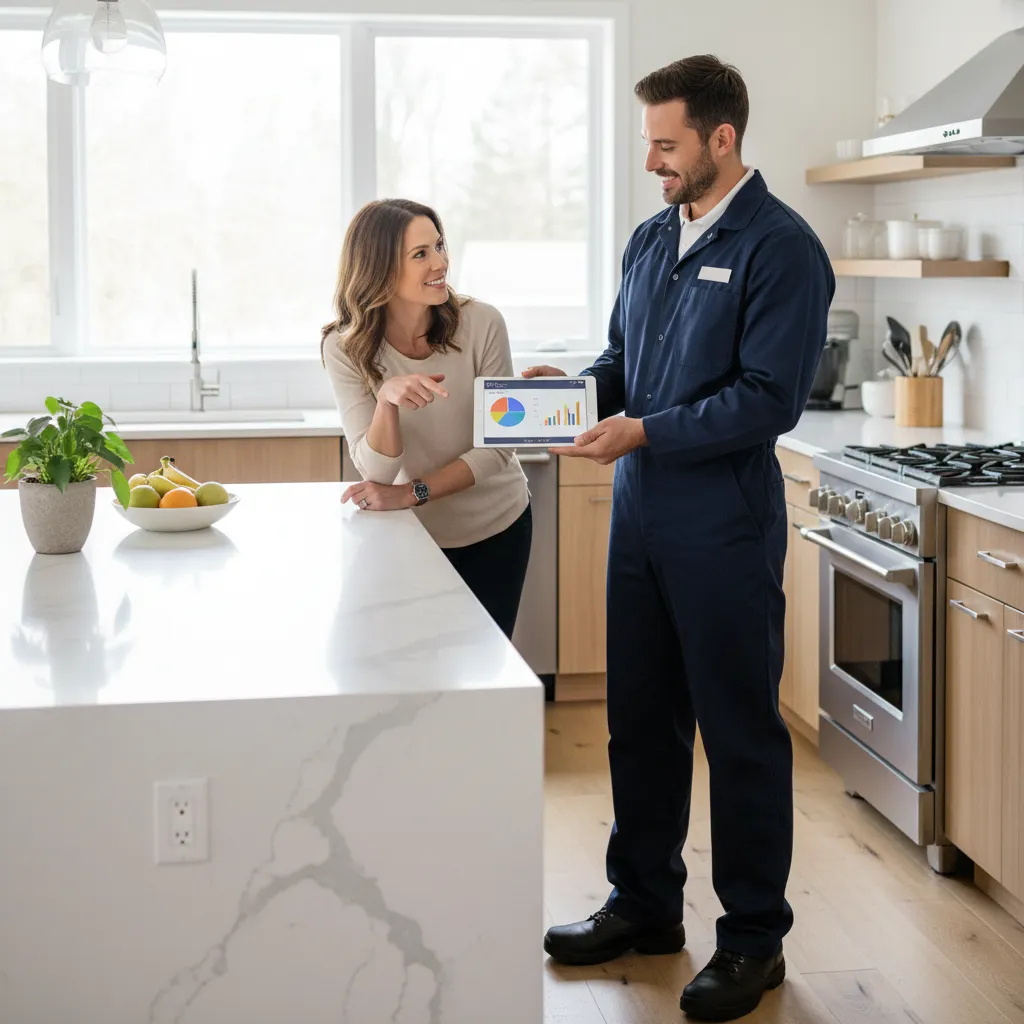
- 2️⃣ Present three-tiered pricing (Good/Better/Best) using visual aids or tablets.
- 3️⃣ 'If you choose to move forward, I can complete this today and waive the $99 trip fee. If you want to think it over, that's fine—you'll just pay the diagnostic fee and I'll leave you with the written quote.'
- 4️⃣ Stop talking and let the customer process.
Notice the tech doesn't hard-close. The pre-framing did the heavy lifting. The customer already knows the fee structure, the pricing model, and the decision framework. The tech is simply facilitating a choice the customer was prepared to make.
SOP Step 5: Post-Job Follow-Up (24 Hours After Completion)
Email or Text: 'Hi [Name], thanks for choosing [Company] for your [service type]. Your work is backed by our [warranty terms]. If you have any questions, reply to this message or call our office. We'd love your feedback—here's a link to leave a review: [link].'
This final touchpoint serves two purposes:
- 🔄 Reinforces Value: Mentioning the warranty reminds them why they paid your rates.
- ⭐ Captures Testimonials: Happy customers who were pre-framed properly leave the best reviews—the ones that mention transparent pricing and professional process.
"📌 Partner Note: All of these SOP steps can be automated through modern CRM integrations. We help plumbing operators set up email sequences, SMS workflows, and callback triggers so pre-framing happens consistently without manual intervention."
Why a Lead Generation Partner is the Right Solution for You
Dolead operates as an operational extension of your business, absorbing the marketing risk by delivering validated, exclusive leads on a strict pay-per-lead model.
About the Author
Guillaume Heintz is a lead generation strategist specializing in home services marketing and operational efficiency. With over a decade of experience helping plumbing, HVAC, and contractor businesses scale profitably, Guillaume focuses on systems that reduce sales friction and maximize lead yield. Connect with him on LinkedIn.


.svg)
.svg)
.svg)
.svg)


