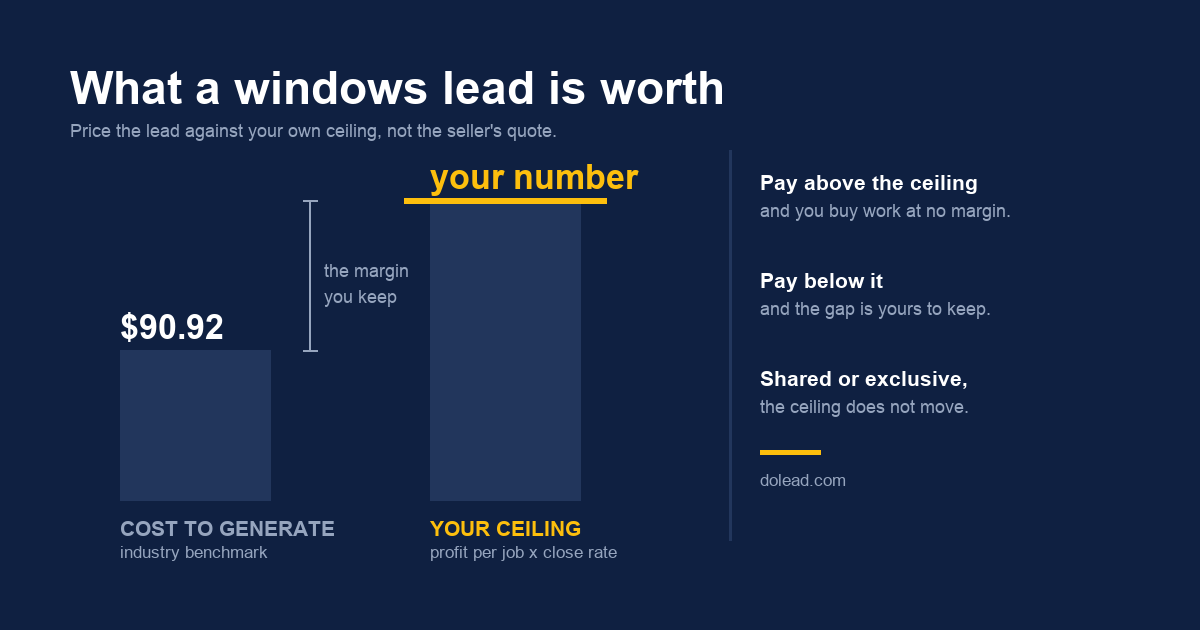
No public price list covers windows and doors leads. The useful anchor is what generating one yourself costs: about $90.92 per lead in the Home and Home Improvement category on paid search. Price any purchased lead against that figure, then against your own cost per signed job.
What do windows and doors leads actually cost?
Sellers quote a price per lead, not a rate card. The number moves with the trade, the territory, the season and how many buyers receive the same inquiry, so two quotes for "windows leads" can differ by a factor of three and both be honest.
What you can anchor on is the cost of producing the same inquiry through paid search yourself. Published 2026 search advertising averages give a clear picture of that floor.
Windows and doors sit inside the Home and Home Improvement row, which is the most expensive of the two on cost per lead. That matters more than it looks. A purchased lead quoted well below the do-it-yourself figure is almost certainly shared with other buyers, and a lead quoted well above it needs a reason you can name, such as verification, exclusivity or a live transfer.
These are averages across many advertisers. Your own account may sit either side of them, and a replacement window campaign in a dense metro behaves nothing like one covering three rural counties. Use the figure as a ceiling for reasoning, not as a target.
Why is there no published price for a windows lead?
Three things stop a rate card from existing.
- The product is not standard. One seller's "windows lead" is a form fill with a name and a postcode. Another's is a homeowner who has confirmed the property type, the number of openings and a budget band. Those are different things and should not carry the same price.
- Exclusivity is defined differently by every seller. A lead sold to one buyer for life, one buyer per territory, or one buyer for seven days before resale are three products with one label. Ask for the definition in writing before comparing any two prices.
- Demand is seasonal and local. Replacement demand concentrates where the housing stock is older and where weather drives the decision, so the same campaign costs more in one market than another in the same month.
The practical consequence is that you cannot shop on headline price. You can only shop on price against a measured result, which is the next section.
What should you be willing to pay per lead?
Work backwards from a signed job. Three numbers decide the answer, and two of them are yours alone.
- Revenue per signed job. A full-house replacement and a single patio door are not the same sale, so use the average for the job type the lead describes.
- Your profit margin on that job, after materials, labour and the crew time it occupies.
- Your close rate on that lead source, measured on signed contracts rather than appointments booked.
Multiply the profit on a typical job by your close rate, and you have the most you can pay for a lead before it costs you money. Decide what share of that ceiling you are willing to spend, and that is your price.
A worked version in words, with no borrowed benchmarks. If you sign one lead in ten, each lead is worth a tenth of the profit on a typical job at break-even. Pay half that and you keep half the value. Pay nine tenths of it and you are buying work at almost no margin while carrying all the delivery risk. The arithmetic is simple; the discipline is measuring the close rate honestly rather than using the one a seller quotes.
This is why cost per lead on its own is a misleading number to manage. For a fuller treatment of that point, read why cost per lead is an incomplete measure of quality.
How do shared and exclusive windows leads differ on price?
A shared lead goes to several buyers, so the seller can charge each of them less. An exclusive lead goes to one buyer and has to carry the full cost of acquiring the homeowner, so it costs more.
The price gap is real and so is the quality gap, but neither tells you which is cheaper per signed job. The break-even rule is the one to remember: if an exclusive lead costs twice what a shared one does, it has to close at more than twice the rate to be the cheaper way to buy work. Below that line the shared lead wins on cost per job, above it the exclusive lead does.
Windows and doors tilt the decision slightly toward exclusivity, for two reasons specific to the trade. The sale usually involves an in-home measure and a written quote, so it takes days or weeks rather than one call, and a homeowner fielding four quotes is comparing on price from the start. The job value is also high enough that losing one to a faster competitor costs more than the premium on several leads.
That is a tilt, not a rule. If you can call within minutes and your jobs are smaller repairs rather than full replacements, shared leads can still produce the lower cost per signed job. The decision belongs to a test, not a preference. For the full comparison across both models, see how shared and exclusive leads compare for buyers.
What changes the price of a door installation lead?
Door leads behave differently from window leads even when the same company buys both, and sellers price them accordingly.
| Factor |
Pushes the price up |
Pushes the price down |
| Job type |
Full entry door systems, patio and bi-fold doors |
Single interior doors, repairs and adjustments |
| Exclusivity |
One buyer, permanent |
Several buyers, or resold after a window of days |
| Qualification depth |
Property type, opening count and budget confirmed |
Name, postcode and nothing else |
| Delivery method |
Live call transfer |
Email or batch file |
| Territory |
Dense metro with high competition |
Rural coverage with few buyers |
Two of those rows are worth pressing a seller on. Qualification depth is the difference between a lead your sales team can work and one they have to re-qualify from scratch, and it is rarely reflected proportionately in the price. Delivery method decides whether speed is even available to you: a lead that arrives in a nightly batch cannot be called in five minutes, whatever your process.
Installation capacity is the constraint behind all of this. A fitting crew is not elastic, so buying more leads than you can measure and install turns a marketing decision into an operational problem, and the backlog shows up as slower callbacks on the leads you already paid for. Some platforms build that limit into the buying model: Google describes Local Services Ads as pay-per-lead listings where you choose the budget based on the number of new leads you want every week, which maps spend onto crew capacity rather than onto an auction. Whatever you buy, set a weekly lead ceiling from the number of measures your team can actually run.
How fast do you have to call a windows lead?
Fast, and faster still if the lead is shared. Speed is the one input that is entirely within your control, and the evidence on it is unusually strong.
In a Harvard Business Review study of 1.25 million sales leads across 42 companies, firms that attempted contact within an hour were close to seven times more likely to qualify the lead than those that waited an hour longer, and more than sixty times more likely than those that waited a day or more.
The same research found the field is slower than it believes. Only 37% of 2,241 audited firms replied to a web inquiry within an hour, 23% never replied at all, and the average reply among those that answered within thirty days took 42 hours. That study predates the current market and did not test windows specifically, but the mechanism carries over directly: when several companies receive the same inquiry, the first to hold a real conversation sets the terms of the comparison.
For a trade where the next step is booking an in-home measure, that first conversation is the whole contest. A competitor who books the measure for Tuesday while you are still dialling has effectively won before either of you has quoted.
How do you test a lead source without guessing?
Run a controlled test and let it run long enough to see signed contracts, not appointments.
- Fix the variables. One trade, one territory, one job type, so both sources face the same demand.
- Match the volume. Buy comparable numbers from each source. A handful of leads produces a close rate that means nothing in either direction.
- Hold your process constant. Same people, same script, same follow-up sequence, same response-time target. If you answer one source faster, you are measuring your own speed rather than the lead.
- Record every stage. Time to first contact, contact made, measure booked, quote issued, contract signed. The drop-off between stages tells you more than the final number.
- Run it for a full sales cycle. For replacement windows that is usually several weeks, because the decision involves a quote and a household conversation.
- Compare cost per signed job, then compare that against the profit on a typical job.
- Decide by segment. The answer is often a mix: exclusive leads for full replacements and high-value territories, shared leads for smaller jobs and for filling a quiet week.
Review the split every quarter. Competition, seasonality and your own response speed all move, and a source that worked in spring may not in November.
If you would rather buy on a measured outcome than on a price per lead, that is the model behind windows installation lead generation and door installation lead generation, where the price is tied to the lead meeting an agreed definition.
What else do windows and doors buyers ask?
What is a reasonable cost per lead for replacement windows?
There is no single correct figure, because it depends on your close rate and your margin per job rather than on the market. As a reference point, generating a comparable inquiry through paid search averaged $90.92 per lead across Home and Home Improvement in 2026. Treat that as the cost of the alternative, then calculate your own ceiling from profit per job multiplied by close rate.
Are exclusive windows leads worth the premium?
Sometimes. An exclusive lead removes the race for the same homeowner, which usually improves the close rate, but it does not guarantee a signed contract and it costs more when it fails. It has to close at a better rate than the price multiple to be worth it: twice the price needs more than twice the close rate.
How many buyers usually receive a shared windows lead?
Sellers vary and most will not volunteer the number. Ask for a cap in writing rather than a description. A seller who cannot state how many buyers receive each inquiry has told you something useful about how the lead is priced.
Should you buy windows and doors leads separately?
Usually yes, because they convert differently and carry different job values. Buying them as one bundle hides which half is performing. Track cost per signed job separately for each, even when the same seller supplies both.
How quickly do windows leads go cold?
Quickly, and shared leads fastest of all. The Harvard Business Review research found contact attempts within the first hour were roughly seven times more likely to qualify a lead than attempts an hour later. For a job that needs an in-home measure booked, the practical deadline is whichever competitor calls first.